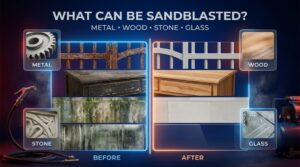
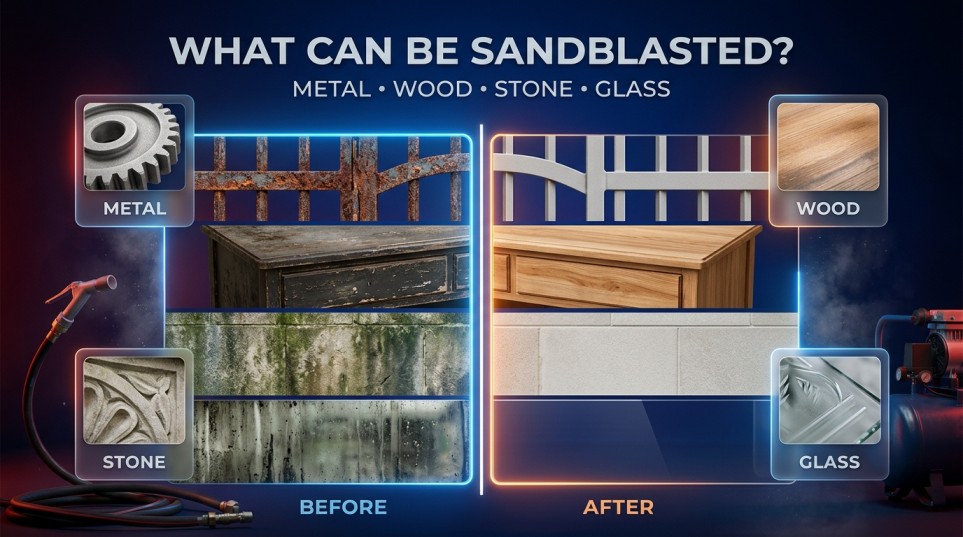
What can be sandblasted? Most solid metal and solid timber items can be sandblasted. Steel, wrought iron, cast iron, aluminium, stainless steel, galvanised steel and solid wood all respond well to abrasive blasting, as long as the media and the pressure are matched to the material. The question is rarely whether something can be blasted; it is how it should be blasted, and whether the item is sound enough to come through the process in one piece.
The items that cause problems are thin sheet metal, plated or machined surfaces, soft plastics, and anything painted before the early 1990s that may contain lead. Those need assessment before any work begins, and some of them should not be blasted at all.
Key points before you book anything in:
- The material decides the abrasive media, and the media matters more than raw pressure. Sand-style mineral grit on soft brass or thin steel causes damage that no amount of care at the nozzle will undo.
- Blasting removes coatings and corrosion. It does not add metal back, fix pitting, or stop rust returning; that is the job of the coating that follows.
- Thin sheet metal, aluminium and brittle castings are blastable, but they need lower pressure and a lighter touch, which is worth flagging when you ask for a quote.
- Lead paint is legally controlled in the UK. If an item has old paint and you are unsure of its age, say so up front rather than after work has started.
- Glass etching and brick, stone and concrete are specialist fields with their own equipment and operators. They are not the same trade as restoring metal and timber items.
What Can Be Sandblasted? Suitable Materials and Items
The table below covers the materials that come through a blasting workshop most often, and how each one is usually treated.
| Material | Suitable for blasting | Notes |
| Steel and wrought iron | Yes | The most common blasting work |
| Cast iron | Yes | Lower pressure, brittle under impact |
| Aluminium and alloys | Yes, with care | Soft, needs the right media |
| Stainless steel | Yes | Media must not contaminate the surface |
| Brass and copper | Yes, with care | Soft, marks easily |
| Galvanised steel | Yes | Zinc comes off; plan to recoat |
| Solid timber | Yes, gentler media | Doors, beams, furniture |
| Thin sheet metal | Yes, carefully | Warping risk at high pressure |
| Glass and crystal | Specialist etching work only | Not general restoration blasting |
| Brick, stone and concrete | Specialist masonry work only | Different equipment and operators |
| Plastics and fibreglass | Rarely | Soft media only, easily damaged |
| Lead-painted items | No, not without assessment | Legally controlled, hazardous |
Why Most Metal and Timber Items Are Straightforward
Abrasive blasting works by firing media at a surface under compressed air. On a solid, sound substrate, the coating and corrosion come away, and the parent material is left behind with a clean, slightly roughened finish. Steel and wrought iron are hard enough to take that impact without losing shape, which is why gates, railings, brackets and structural steel make up the bulk of most workshops’ intake.
Solid timber is softer, but it is also forgiving when the media is changed. Dropping to a gentler abrasive and a lower pressure lifts the varnish or paint while leaving the wood intact, though the grain will usually be raised a little.
The straightforward jobs share two things: enough thickness to absorb the blast, and a finish nobody is trying to preserve underneath. Problems start where one of those is missing: a panel too thin to stay flat, or a plated, polished, or machined surface that the blast would destroy on contact.
Metal Items That Are Routinely Blasted
Gates, Railings and Architectural Ironwork
Wrought iron and mild steel gates are among the most common items brought in for blasting, usually because decades of repainting have built up a thick, flaking shell with rust working underneath it. Blasting strips the whole paint history back to bare metal in one process, which is why it is the normal first step before repair welding or repainting.
It also shows you what you actually own. Once the paint is off, weak scrollwork, failed welds, previous filler repairs and hinge wear are visible, and a decision about repair or replacement can be made on evidence rather than guesswork. For driveway and garden gates in particular, that assessment matters more than the cleaning`; a gate with sound bar stock and surface rust is worth restoring, while one that is thin and perforated along the bottom rail may not be. Our gate sandblasting page goes into how that work is handled.
Railings, balustrades, estate fencing, brackets and decorative ironwork follow the same pattern. Sections with fine detail need a careful approach, because aggressive blasting can soften crisp casting and scrollwork over repeated passes.
Vehicle Parts, Wheels and Motorcycle Components
Chassis parts, subframes, suspension components, brackets, alloy and steel wheels, frames, swingarms and engine casings are regular work. These items usually carry a mix of underseal, old paint, powder coating and road corrosion, and they are being prepared for refinishing rather than simply cleaned.
Parts rather than whole vehicles are the usual rule. Bodywork panels are thin and prone to distortion; bearing surfaces and threads have to be masked or plugged, and anything with bushes, seals or electrics in it needs stripping down before it arrives. Alloy wheels also need different media from steel, as mineral grit that suits a cast bracket will pit an alloy rim.
Cast Iron Radiators and Metal Furniture
Victorian and reproduction cast iron radiators strip well, inside and out, and blasting clears the scale and paint that sits between column sections where hand tools cannot reach. Cast iron is brittle, so pressure is kept down, and the angle of attack controlled; a casting that is already cracked or has been repaired will not be made stronger by blasting, and existing faults may open up.
Garden benches, table frames, bed frames, fire surrounds and metal garden furniture are handled the same way. Where an item combines cast sections with thin pressed steel or tube, the two parts may need different treatment on the same job.
Brackets, Fittings and Small Fabrications
Small steel fabrications, shelf brackets, gate furniture, hinges, agricultural fittings, plant and machinery parts, tools, trailer components are quick, predictable work. The main consideration is the finish required afterwards, because parts headed for galvanising, powder coating or wet paint each want a slightly different surface condition.
If you have a batch of similar parts, mention the quantity and what happens to them next. Preparing fifty brackets for powder coating is a different job from cleaning one bracket for the garage shelf, even though the material is identical.
Timber and Mixed-Material Items
Wooden Doors, Beams and Solid Timber
Solid timber takes blasting well when the media is chosen for it. Panelled doors, oak beams, staircase parts, furniture frames and reclaimed timber are usually brought in to remove old varnish, paint or limewash without the mess and chemical residue of stripping by hand.
The result is a clean, matt surface with the grain slightly raised and the texture a little more open than it was. Some people want exactly that look on beams and reclaimed wood; anyone expecting a smooth, sanded finish straight off the blast should plan on light sanding afterwards.
Veneered boards, plywood, MDF and chipboard are a different matter. Thin veneer lifts or burns through, and manufactured boards break up under the blast, so they are generally not suitable.
Why Timber Needs Gentler Media and Lower Pressure
Wood is far softer than steel, so an abrasive that cleans a gate will cut into timber instead of lifting the coating off it. Softer media, soda and crushed walnut shell among them, do the opposite: they take the finish away while doing less to the wood underneath.
Pressure and nozzle distance matter just as much as the media choice. Too close or too hard, and the soft spring growth in the grain erodes faster than the dense summer growth, leaving a ridged, scoured surface that cannot be put back. Softwoods such as pine are more vulnerable to this than oak.
This is also why a single quote for “blasting” rarely fits a mixed load. Timber takes a different setup from metal, and that setup change is part of the job.
Items That Combine Metal, Timber and Glass
Plenty of items arrive with more than one material in them: a wooden gate with iron strap hinges, a garden bench with cast ends and timber slats, a leaded window in a metal frame, a door with glazing still fitted.
There are three options for mixed items, and the right one depends on the piece. Components can be separated before blasting, which gives the best result because each material is treated correctly. Sensitive areas can be masked, which works for small fittings but is not reliable across large areas of glass. Or the whole item can be worked at a setting safe for the most delicate material in it, which protects the piece but removes coatings more slowly.
Dismantling is worth raising early. If you can unbolt hinges, remove glazing or unscrew timber slats before the item arrives, the work is usually cleaner and more predictable.
What Sandblasting Actually Removes
Rust, Corrosion and Mill Scale
Blasting takes off rust and corrosion products, along with the mill scale that forms on hot-rolled steel during manufacture. On a gate or railing, it clears the loose flaking layers and the rust that has crept under the paint film, back to sound metal.
What it cannot do is replace the metal that corrosion has already eaten. Where rust has been working for years, the surface underneath will be pitted, and deep pitting stays visible after blasting because it is a loss of material rather than a deposit on top. On badly corroded items, blasting sometimes opens pinholes that were there all along, hidden under scale and paint.
It is also worth being clear about what happens next. A freshly blasted steel surface is chemically clean and will begin to oxidise again in normal workshop air, which is why primer or the first coat is applied promptly rather than days later. Blasting prepares a surface for protection; the coating system, the environment it lives in and the maintenance it gets are what determine how long that protection lasts.
Paint, Varnish, Powder Coating and Underseal
Most common finishes come off: household gloss, primer, lacquer, varnish, emulsion, powder coating, underseal, bitumen-based coatings and multiple layers of all of them. Thick, brittle paint stacks tend to come away quickly once an edge is opened up.
Some coatings are stubborn. Modern two-pack epoxies and industrial polyurethanes are tough and well bonded; factory powder coating on alloy can be slow going; and rubberised underseal softens and smears rather than breaking away cleanly. These are removable, but they take longer, which affects the quote.
Whether a coating is removed completely depends on its type and thickness, the condition of the surface and the approach used, so a realistic answer on any particular item comes from looking at it rather than from a general rule.
What Blasting Will Not Remove
Blasting is a surface process, and some things are not on the surface:
- Pitting, dents, bends, and lost metal. The blast cleans them; it does not fill them. Filling or welding is separate work.
- Rot, woodworm damage, and delamination in timber. These are failures in the material itself.
- Cracks in castings and failed welds. Blasting usually makes them more obvious, which is useful, but it is not a repair.
- Rust bleeding from inside box sections. Corrosion inside a hollow section keeps working after the outside is cleaned.
- Grease, oil, and heavy contamination. These are degreased before blasting, not by it, since oil driven into a surface interferes with the finish and contaminates the abrasive.
- Stains in porous surfaces. Blasting works on what sits on top, not on what has soaked in.
Materials That Need Careful Handling
These materials are all blastable. They simply have a narrower margin for error, and knowing where the risk sits helps you describe your item accurately when you ask for a price.
| Material | What can go wrong | How it is handled |
| Thin sheet steel | Rippling and warping from heat | Lower pressure, shorter passes |
| Aluminium | Surface pitting, excess metal loss | Softer media, controlled distance |
| Cast iron | Cracking on brittle castings | Reduced pressure, careful angle |
| Machined or plated surfaces | Finish destroyed permanently | Masked off or not blasted at all |
| Soft woods | Grain raised too aggressively | Soda or walnut shell media |
| Heavily corroded metal | Blasting opens holes already there | Assessed before work starts |
The last row is the one that surprises people most often. Where an item is already perforated beneath its paint, blasting reveals the damage rather than causing it, but the holes appear during the process, so it is better to expect that possibility from the outset on anything heavily rusted.
Why the Media Matters More Than the Pressure
It is tempting to think of blasting as a single process with a dial on it, where soft materials just get a lower setting. In practice, the abrasive does most of the work, and the wrong abrasive cannot be made safe by turning the pressure down.
Different media behave differently. Angular mineral grit cuts hard and leaves a rough profile, which suits steel going under a protective coating. Glass bead is rounder and leaves a smoother, brighter finish. Soda and walnut shell are gentler again and are used where the substrate must not be cut into, such as timber and some soft metals. The choice depends on the material, the coating being removed, and the finish wanted afterwards.
Contamination is a factor as well. On stainless steel, media that leaves iron particles behind can cause surface rusting later, so the abrasive has to be compatible with the metal and not just capable of cleaning it.
There is no universal setting and no universal abrasive, which is why a workshop will usually want to see the item, or clear photographs of it, before committing to an approach.
What Should Not Be Blasted
Lead Paint and Pre-1992 Coatings
Lead was used in paint for decades before it was restricted for general sale in the UK in the early 1990s. On older gates, railings, window frames, radiators and architectural ironwork, there is a reasonable chance that one of the early coats contains it.
Blasting lead paint turns a solid coating into fine airborne dust, which is why work involving lead is controlled under UK health and safety law and is not treated as ordinary paint removal. It needs identification first, then containment, filtration, monitoring and controlled disposal of the waste, a different scope of work from a standard blast, and not something to be taken on casually.
Two practical points. Do not sand, grind, burn off or blast suspected lead paint yourself, indoors or out; the dust is the hazard, and domestic equipment does not contain it. And if your item is old or of unknown history, say so when you enquire. It is far easier to test and plan at the quote stage than to stop work partway through.
Items Too Far Gone to Survive the Process
Some items are past the point where blasting helps. Metal that flexes or crumbles under thumb pressure, gates where the bottom rail has corroded through, panels perforated along a seam, or timber that is soft with rot will not come out of the process better than they went in.
The honest test is whether enough sound material remains to be worth preparing. If an item would need extensive new metal welded in after blasting, the cost of restoration can exceed the cost of a replacement, and it is better to know that before the work than after.
That said, items often look worse than they are. Heavy surface rust on thick bar stock is usually cosmetic, while a thin, neatly painted item can be hiding real loss. This is exactly what an assessment is for: judging the item by thickness and condition, not by how bad the paint looks.
When a Gentler Method Is the Honest Answer
Blasting is not always the right tool, and a workshop worth using will say so. Chemical dipping is sometimes a better route for intricate or delicate items. Hand stripping, scraping, or careful sanding suits small areas and items with finishes worth preserving. Where only a light clean is needed, washing and degreasing may be all the item calls for.
There are also cases where replacement is the sensible recommendation, or where a specialist in another trade, masonry cleaning, glass etching, furniture restoration, is the right person to speak to.
If you are told that blasting is not suitable for your item, that is useful information rather than a lost cause. It usually means someone has looked properly instead of quoting for a process that was never going to work.
Getting Something Blasted in Reading
Blastec Sandblasting Services carries out metal and timber sandblasting for customers in Reading and across Berkshire, from single gates and radiators to batches of fabricated parts.
Four things make a quote accurate, and they are all easy to supply:
- What the item is made of, as far as you know: wrought iron, cast iron, steel, aluminium, solid timber, or a mix.
- Its size and rough thickness, and whether any section feels thin or soft.
- What is on it now: paint, varnish, powder coating, underseal, rust, and roughly how old the item and its paint are.
- What happens next, whether that is repair work, priming, painting, powder coating or galvanising.
Clear photographs help more than descriptions, especially close-ups of the worst-affected areas and of any joints, hinges or fittings. If something is heavily corroded, a photo of the bottom edge or underside is usually the most informative.
It is also fair to ask questions of any blasting contractor before you commit:
- What media would you use on this material, and why?
- What will the surface look and feel like afterwards?
- What could go wrong with an item like this?
- Should anything be dismantled or masked before it comes in?
- Is any coating or priming included, or does that need arranging separately?
- How is the old paint waste handled?
To discuss an item, send photographs and a description through the sandblasting services site, and you can be given an honest view of whether blasting suits it, what approach it would take, and what to budget for. If blasting is not the right answer for your item, you will be told that too.
Conclusion
Most solid metal and solid timber items can be sandblasted, and for gates, railings, cast iron, vehicle parts and wooden doors it is usually the most thorough way to get back to a clean surface. The real variables are the abrasive media, the pressure and the condition of the item itself, not whether blasting is possible in principle.
The exceptions are worth remembering. Thin sheet metal, aluminium, brittle castings and soft woods need a lighter approach. Plated and machined finishes should be masked or left alone. Glass etching and masonry cleaning are separate specialisms. And lead paint is a controlled material that calls for assessment before anything else happens.
If you are weighing up whether to restore, repair or replace something, blasting often answers the question by showing you what is actually left under the paint. A short conversation about the item, with a few photographs, is usually enough to tell you whether it is worth doing.