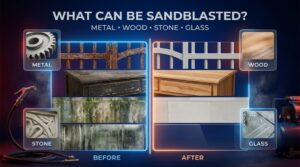
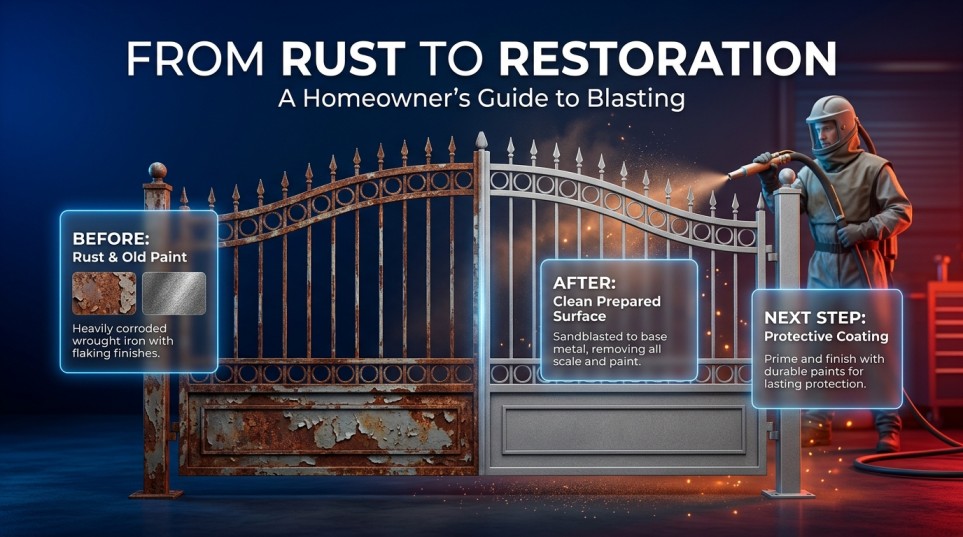
Blasting uses compressed air to drive an abrasive media against a surface, stripping away paint, rust, old coatings, and surface contamination and leaving the material underneath exposed. For most homeowners, it is a single step in a longer job: the gate, the wheels, the radiator or the chassis goes out dirty and painted, comes back bare, and then goes straight on to a painter, powder coater or galvaniser. What it costs, how long it takes and how the finished surface looks depend on the item, the material it is made from, what has been put on it over the years, and the condition of what is left underneath.
This homeowner guide to blasting sets out the six decisions that shape a domestic job in Reading and the surrounding Berkshire area, in the order you will actually meet them: whether blasting is the right method at all, where the work has to happen, how to get a price you can rely on, what to strip off the item first, what needs to be lined up for afterwards, and how to check the work before it leaves.
Key Takeaways
- Price tracks condition and preparation far more closely than size. Two gates of the same dimensions can sit at opposite ends of a quote range because of what is on them.
- Most domestic items are blasted at a workshop. Anything fixed in place, hung gates, set railings, structural steel, needs a different conversation about on-site work and containment.
- Freshly blasted bare steel starts to flash rust quickly, especially in damp British weather. The coating stage needs to be arranged before the blasting is booked, not after.
- Removing fittings, tyres, glass, valves and wiring yourself before the item goes in usually saves both time and money, and avoids damage to parts that were never meant to be blasted.
- An accurate quote depends on what you send with the enquiry. Clear photographs, measurements and an honest description of the coating and corrosion are worth more than a phone description.
What It Costs and How Long It Takes
Most homeowners want the numbers before anything else, so here they are. The figures below are typical ranges for domestic blasting work, not quotes. They assume an item in ordinary condition, delivered prepared, with no unusual coating or contamination. Turnaround is the time the item spends with the blaster once it arrives, not including delivery, collection, or any painting that follows.
| Item | Typical price | Typical turnaround |
| Set of four alloy wheels | £100 – £180 | Same day to next day |
| Single garden or side gate | £60 – £140 | Same day |
| Pair of driveway gates | £120 – £320 | Same day to next day |
| Cast iron radiator | £80 – £200 | Same day to next day |
| Garden furniture set | £120 – £300 | 1 – 2 days |
| Railings, per metre | £25 – £60 | 1 – 2 days |
| Wooden door | £35 – £90 | 1 – 2 days |
| Car chassis | £400 – £900 | 3 – 5 days |
Use these as a sense of scale when you are budgeting a restoration, not as a figure to hold anyone to. A sandblasting quote in Reading is always based on the actual item.
Why Your Own Quote May Sit Outside These Ranges
The ranges above are wide for a reason. Several things move a job up or down within them, and occasionally past them altogether.
What is actually on the item. A gate carrying one coat of flaking gloss is a different job from a gate carrying forty years of layered paint over a bituminous primer. Thick, soft, multi-layer coatings take longer to break through and consume more abrasive. Some older finishes release in sheets; others smear.
How much corrosion there is, and how deep. Light surface rust lifts easily. Heavy scale, pitting and perforation take longer, and more of the operator’s attention, because the surrounding sound metal has to be treated carefully while the corroded areas are worked.
The shape of the item. Flat panels are quick. Scrollwork, finials, mesh infill, box sections, tight internal corners and anything with blind recesses all take longer, because every face has to be reached from the right angle.
What the item is made of. Cast iron, mild steel, aluminium, galvanised steel and timber all respond differently and may call for different media and a different approach. A set of alloy wheels is not treated like a steel chassis.
What has been done to it before. Filler, lead loading, previous welded repairs, plating and old galvanising all change what appears as the coating comes off, and sometimes change the method.
Where the work happens and how accessible it is. Items brought to a workshop are generally the most economical. Work carried out at a property involves setting up, containment, protection of the surrounding area and clean-up afterwards, all of which carry time.
Quantity. Six matching railings handled together usually cost less per metre than one. Blasting carries a set-up cost that is spread across whatever is in front of the operator.
Sandblasting cost in Reading also moves with the obvious practical factors: how far the item has to travel, how quickly you need it back, and whether the job has to be fitted around other work in the diary.
Step One: Deciding Whether Blasting Is the Right Call
Before you start ringing round for prices, it is worth being clear about what you are asking blasting to do. There is a difference between cleaning a surface and preparing one. Cleaning removes dirt, loose material and surface contamination. Preparation goes further: it takes the surface back to the parent material and leaves a texture, or profile, that a coating can grip.
Most domestic jobs are preparation jobs, even when they are not described that way. If the item is going to be painted, powder coated or galvanised afterwards, the quality of what happens underneath that coating matters more than how the bare item looks on the day it comes back.
When Blasting Beats Scraping, Sanding and Wire Brushing
Hand methods have their place. A single flat panel with one thin coat of paint can be sanded in an afternoon. Blasting tends to earn its cost when one or more of the following applies.
- The item has complicated geometry. Scrollwork, cast detail, mesh, tubing, railings, and finials are slow and frustrating by hand, and hand tools cannot reach into corners and undercuts at all. Blasting reaches where a sanding block cannot.
- There are many layers of coating. Decades of repainting defeat chemical strippers and clog abrasive paper. Blasting works through layers rather than skimming them.
- There is rust in and around the detail. A wire brush polishes rust in pitting rather than removing it. Blasting lifts corrosion products out of the pits so what remains can be seen and assessed properly.
- A coating is going on afterwards and needs to last. A coating applied over residual rust, polished metal, or trapped old paint is working against the surface underneath it. Preparation is the part of the job that most affects how the finish behaves in year three, not week one.
- The surface area is simply too large for hand work to be realistic. A car chassis, a set of driveway gates, a full garden furniture set.
Blasting is not automatically the right answer. Items with delicate original finishes, thin or already perforated sections, decorative patina worth keeping, or construction that relies on filler or soft solder may be better handled another way, or handled in part by hand. That judgement should be made on the item, not on a general rule.
When an Item Is Too Far Gone to Be Worth It
This is the conversation homeowners most often wish they had had earlier. Blasting removes coatings and corrosion products. It does not add material back. Everything that was eaten away by rust before the item arrived will still be missing afterwards, and once the paint is off, it becomes visible for the first time.
Signs an item may not justify the spend:
- Perforation. Holes already showing through the section, particularly along the bottom rails of gates, the feet of railings, the lower edges of radiators or the sills and outriggers of a chassis.
- Section loss you can feel. Metal that flexes, dents under thumb pressure, or sounds dull when tapped has usually lost real thickness.
- Corrosion concentrated at joints. Rust at welds, tenons and collars is harder to deal with, because those are the points that carry the load.
- Heavy filler. On a car panel or a repaired casting, a thick filler layer often turns out to be hiding damage rather than a minor imperfection.
- Timber with soft, spongy or flaking areas. Wood that has gone past surface weathering into rot will not be improved by taking the coating off it.
None of this means the item is scrap. Plenty of gates, radiators and chassis are blasted, welded, patched and go on to another few decades of service. But it does mean the honest question is a comparison: blasting plus repair plus coating, against replacement. If you have doubts, say so in your enquiry and ask for the item to be looked over before any blasting starts.
Step Two: Working Out Where the Job Happens
There are two ways a domestic blasting job gets done, and which one applies changes the price, the timescale and what you need to organise.
At the workshop. You deliver the item, or arrange collection, and it is blasted in a controlled enclosure. This suits anything that can be detached and transported: alloy wheels, radiators, garden furniture, gates that can be lifted off their hinges, individual railing panels, doors, car parts and smaller fabrications. It is usually the quicker and more economical route, because the set-up is already in place, dust and spent abrasive are contained by the booth rather than by temporary screening, and the operator can work from every angle.
At the property. Mobile sandblasting services bring the equipment to the item. This is the answer when the item cannot reasonably be removed, but it carries extra work: masking and protecting nearby surfaces, cars, glazing, planting and neighbouring property, managing dust and spent media, and clearing up afterwards. Weather matters too, because blasted bare metal exposed to rain or heavy damp will not stay bare for long.
If you have a choice, taking the item to the workshop is normally the better value. If you do not have a choice, say so at the enquiry stage rather than after a price has been given for workshop work.
Items That Have to Be Blasted Where They Stand
Some items are genuinely fixed. Common examples around Reading properties include:
- Driveway gates with automation. Underground or ram-arm motors, loop detectors, and buried cabling can make removal a bigger job than the blasting itself. Sometimes the gates still come off, with the installer’s involvement; sometimes they do not.
- Railings set into stone or concrete. Victorian and Edwardian railings leaded into a coping stone cannot be lifted without breaking out the fixing, and the repair afterwards may cost more than the blasting.
- Balustrades, balconies and fire escapes. Structural items that are holding something up, or stopping someone falling, are not removed casually.
- Fixed garden structures. Pergolas, arches, large canopies and anything bolted to a wall or set in footings.
- Vehicles still on their wheels. A shell or chassis that cannot be stripped and transported changes the whole scope of the work.
For any of these, the first step is a look at the item rather than a price over the phone. Access, surroundings, the proximity of neighbours, parking for equipment and what sits underneath the item all shape what can be done and how long it takes. Ask whether on-site work is offered for your particular item before assuming it is.
It is also worth raising the age of the coating. Paint applied to ironwork before the late 1990s may contain lead, and older coatings on some items may contain other hazardous constituents. That is not a reason to panic, but it is a reason to mention it, because it affects how the work is set up, contained, and cleared away. Never attempt to strip a suspect coating yourself with a hired blaster, a grinder,r or a heat gun.
Step Three: Getting a Price You Can Rely On
A blasting quote is only as good as the information behind it. Most of the frustration homeowners report comes from the same place: a figure given over the phone on the basis of “a pair of gates”, followed by a different figure once the gates were actually seen.
You can avoid most of that. Send enough detail up front,t and the price you are given will hold, or the reasons it might not will be explained before you commit.
What to Send With Your Enquiry
- Photographs of the whole item, from both sides. Take them in daylight, with the full item in frame, so the shape and construction are clear.
- Close-ups of the worst areas. The rusty bottom rail, the flaking corner, the area you are worried about. Hiding the bad bits only delays the real number.
- Measurements. Height, width, and, for railings, total length in metres. For gates, the overall size of each leaf.
- The material, if you know it. Wrought iron, cast iron, mild steel, aluminium, galvanised steel, timber. If you are unsure, say that too; a photograph usually settles it.
- What is on it now. Paint, powder coat, galvanising, varnish, bitumen, or a mixture. An estimate of how many times it has been repainted is useful.
- Age, if you have an idea. This matters for the coating question raised above.
- Where it is and whether it can be moved. Postcode or area, and whether you can deliver, need collection, or need the work done on site.
- What happens next. Painting, powder coating, galvanising, or straight back into use. This affects the finish the blaster should leave.
- Your timescale. Whether you are working to a date, and how flexible it is.
That list takes ten minutes to put together, and it is the single biggest thing in your control. Sandblasting turnaround time also becomes far easier to confirm when the item is understood before it arrives.
Why Some Quotes Can Only Be Confirmed Once Work Starts
Even with good photographs, some jobs carry genuine unknowns, because the coating is hiding the thing being quoted on. An honest blaster will tell you where those unknowns sit rather than quoting around them.
The usual ones:
- Corrosion depth. Surface rust and deep pitting can look similar under paint. The extent only becomes clear as the coating comes away.
- Previous repairs. Welded plates, brazed joints, filler, and old patches appear during blasting, not before it.
- Coating behaviour. Some finishes come off far more readily than their appearance suggests, and some tough modern coatings hold on much harder than expected.
- Hidden construction. Mesh behind panels, internal bracing, lead or solder joints, and timber cores inside metal frames all change the approach.
- Rot under paint on timber. A sound-looking painted door can turn out to be soft in the bottom rail.
The practical way to handle this is to agree a price for the work as described, together with an understanding that if something significantly different is found, work pauses and you are contacted before it continues. That is a reasonable thing to ask for, and a reasonable thing for a blaster to offer. What you should be wary of is a very low figure given with no questions asked at all.
Step Four: Preparing the Item Before It Goes
Blasting equipment does not distinguish between the coating you want removed and the component you want to keep. Anything soft, sealed, electrical, glazed, or rubber needs to come off first, or be flagged clearly so it can be masked.
Preparing items for sandblasting is work you can usually do yourself with ordinary tools, and it is worth doing. It shortens the job, keeps the cost down, and protects parts that would be expensive to replace.
| Item type | What you need to remove or flag first |
| Gates and railings | Locks, latches, drop bolts, automation wiring |
| Alloy wheels | Tyres, valves, balance weights, centre caps |
| Car parts | Rubber bushes, brake and fuel lines, wiring |
| Radiators | Valves, blanking plugs, any remaining water |
| Garden furniture | Cushions, fixings, plastic feet |
| Wooden doors | Glass, handles, hinges, letterplates |
A few additional points that come up often:
- Cast iron radiator blasting needs the unit fully drained and dry inside. Water left in a radiator will find its way out during handling, and any remaining sludge makes a mess of everything it touches.
- Alloy wheel blasting requires tyres off, not just deflated. Tyre fitters will usually do this cheaply while the wheels are off the car.
- Car chassis blasting needs every flexible line, bush, mount and wiring loom out of the way. If something has to stay in place, point it out specifically.
- Gate and railing sandblasting goes more smoothly when hinges, locks and any electrical gear are removed and bagged. Keep the fixings; matching old ironmongery afterwards is harder than it sounds.
- Garden furniture sandblasting means cushions, straps, slats and plastic feet removed, and any timber elements separated from the metal frame if they are coming off at all.
If a part genuinely cannot be removed, do not hide it. Say what it is and where it is, and ask whether it can be masked or worked around.
What Happens If an Item Arrives Unprepared
Usually one of three things, none of which help you.
The work takes longer and costs more, because stripping components is time the operator spends not blasting. The item waits, because it cannot be put into the booth until it is ready, which pushes your turnaround back behind other jobs. Or a part gets damaged, a valve seat scored, a tyre ruined, a pane of glass lost, a wiring loom caught, and that is a replacement cost on top of everything else.
In some cases the item is simply sent back. A radiator still holding water, or a wheel still on its tyre, is not something that can be worked around on the day. Half an hour of preparation at home avoids all of it.
Step Five: Lining Up What Happens Next
Blasting is a preparation stage, not a finish. The item that comes back to you is bare and unprotected, and from that moment the clock is running. The homeowners who get the best results are the ones who treated blasting as the middle of the job rather than the end of it.
Before you book, you should know three things: who is applying the coating, what that coating will be, and when they can take the item.
Why Bare Metal Cannot Wait for Your Painter
Freshly blasted steel and iron have no protection at all. The old coating is gone, the corrosion products are gone, and what is left is clean, reactive metal with a textured surface that holds moisture readily. In British humidity, a light bloom of flash rust can appear on bare steel surprisingly quickly; in damp or unheated conditions, it can show within hours rather than days.
That matters for two reasons. The surface you paid to have prepared starts changing immediately, and a coating applied over flash rust is not sitting on the surface it was supposed to sit on. In many cases,s the item has to be prepared again before coating, which means paying twice.
Practical handling in the meantime:
- Keep the item somewhere dry, ventilated, ed and reasonably warm. A damp garage or an open carport is not storage.
- Do not handle bare metal with bare hands more than necessary. Skin oils and salts transfer onto the surface.
- Do not leave it covered with a sheet of plastic, which traps condensation against the metal.
- Get the first coat on as soon as you reasonably can.
Timber is different but no more forgiving. A blasted door left outdoors will take up moisture and move, which causes problems when it is later coated and rehung.
The Mistake Most Homeowners Make Here
The common sequence is backwards: book the blasting, collect the bare item, then start ringing round for a painter or powder coater. By the time someone is available, the surface has already changed.
The better sequence is to line the coating up first. Speak to your painter, powder coater or galvaniser before anything is booked, find out when they can take the item, and then arrange the blasting to land just before that slot. Ask them two questions while you are at it: what surface condition they want the item delivered in, and whether they have any preference about the preparation. Powder coaters and galvanisers sometimes have specific requirements, and a short conversation beforehand is worth more than an assumption.
If there will be an unavoidable gap, ask whether a holding primer is appropriate for your item and your intended final coating. It will not suit every job, and it has to be compatible with what goes on top, but it is a sensible question to raise rather than leaving bare metal to its own devices.
One last thing to be clear-eyed about: blasting prepares a surface well, but how long the finished item resists corrosion depends on the whole system, the preparation, the coating chosen, how well it is applied, where the item lives, and how it is maintained. A properly prepared and properly coated gate exposed to a Berkshire winter still needs looking at from time to time.
Step Six: Checking the Work Before It Leaves
Take ten minutes with the item before it goes back on the trailer. Problems are far easier to put right while the item is still at the workshop than after it has been painted.
What to look at, with the item in good light:
- Run your eye over the detail areas rather than the flat faces. Corners, scroll backs, the undersides of rails, the inside faces of box sections and anywhere two components meet.
- Check for remaining coating in recesses, particularly where paint had built up thickest.
- Look for spent abrasive trapped in hollow sections, tube ends and mesh. It will fall out later, often onto wet paint.
- Note any perforation, thinning, or old repair that has been revealed. This is the moment to decide whether welding or patching is needed before coating.
- If anything was masked, check the masking held.
If something does not look right, ask about it there and then. A reasonable blaster would far rather deal with it on the spot.
What a Properly Blasted Item Looks Like
On steel and iron, expect a uniform matt grey surface with a consistent dull texture, free of coating, scale and loose corrosion products. It should not be shiny; the fine roughness is deliberate, and it is what a coating grips. The colour should be reasonably even across the whole item, without patches that look darker, glossier, or smoother than the surrounding area; those usually mean something is still there.
Other materials look different. Aluminium typically comes back lighter and more silvery with a satin texture. Cast iron often shows a slightly coarser, more open surface than mild steel, because of the grain of the casting. Timber comes back with the grain raised and the softer early wood cut back further than the hard grain, giving a textured rather than a sanded-smooth surface.
A few things to expect that are not faults:
- Pitting is still visible. Blasting cleans pits out; it does not fill them. Deep pitting on an old gate will still be deep pitting afterwards, and that is a filling-and-finishing question for the coating stage.
- The item may look worse than you expected. Paint hides a great deal. Seeing the true condition for the first time is often a shock, and it is also exactly what you needed to see before spending money on a finish.
- Old repairs show up. Welds, braze, and filler become obvious once there is nothing covering them.
What should not be there: significant areas of remaining coating, polished bright patches, visible surface damage on sound metal, or media packed into assemblies.
Homeowner Guide to Blasting Services in Reading and Berkshire
Blastec Sandblasting Services carries out residential and domestic blasting work for homeowners and property owners in Reading and across Berkshire. Typical domestic items include driveway and garden gates, railings, cast iron radiators, garden furniture, alloy wheels, car and motorcycle parts, and timber doors.
If gates are what brought you here, the gate sandblasting service page covers that work specifically, including what happens with hinges, locks and automation. For the full range of domestic and commercial blasting work, start from the Blastec Sandblasting Services homepage.
When you get in touch, bring the information from Step Three with you: photographs of the whole item and of the worst areas, measurements, what the item is made of, what is on it now, whether it can be moved, and what coating is planned afterwards. With that in hand, you will get a realistic figure, a realistic turnaround, and an honest answer about anything that cannot be confirmed until the coating starts coming off.
If you are not yet sure whether the item is worth restoring, say so. That is a sensible question to ask before any work is booked, and it is better answered by someone looking at the item than by guesswork.
Request a quote for your blasting project, or send photographs of the item and ask for an assessment before you commit to the work.
Conclusion
Blasting is a straightforward service wrapped around a few decisions that are easy to get wrong if nobody explains them. Work out whether the item justifies the spend before you book. Establish early whether it can be moved or has to be treated where it stands. Give a blaster enough information to price the job properly, and expect honesty about what cannot be known until the coating is off. Strip the fittings yourself. Have the coating stage arranged before the item comes back bare. Then take a few minutes to look the work over before it leaves.
Done in that order, a domestic blasting job is usually quick, predictable and good value, and it puts the item in the best condition it can be in for whatever finish goes on next. Done in the wrong order, the same job tends to involve waiting, rework and a second bill.
If you have an item in Reading or elsewhere in Berkshire that you are thinking about, the useful first step is simply to send photographs and ask.