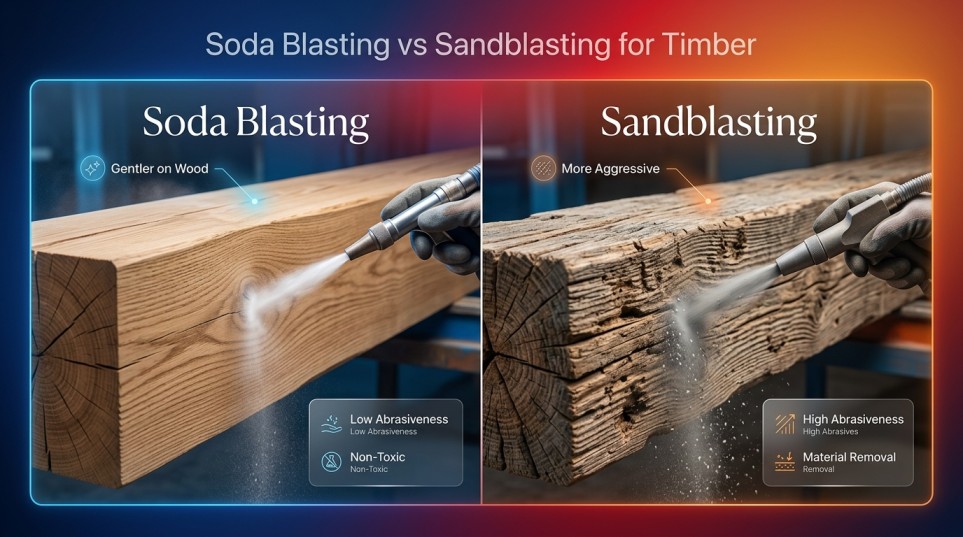
Quick verdict: Soda Blasting vs Sandblasting for Timber is a key consideration if you are trying to strip paint from oak beams, clean up reclaimed timber, or bring back a smoke-damaged frame. Quick verdict: For almost all timber work, soda blasting is the safer method. Sodium bicarbonate is soft enough to lift paint, varnish, mould and smoke damage while leaving the wood fibre largely intact, whereas traditional sandblasting uses a hard cutting abrasive that erodes soft grain and can gouge the surface. Sandblasting still has a place on very hard, heavily contaminated or structurally robust timber, but only after a test patch proves the wood can take it.
If you are trying to strip paint from oak beams, clean up reclaimed timber, or bring back a smoke-damaged frame, the method matters more than the machine. Timber is not steel. It has soft spring growth and hard summer growth in the same board; it holds moisture, and it cannot be re-profiled once material has been cut away. Choosing between soda blasting and sandblasting is really a choice about how much of the original surface you are willing to lose.
This guide explains how each method behaves on wood, what sandblasting actually does to timber at a fibre level, when soda blasting is and isn’t the right answer, and what to check before anyone brings a pot on site.
Soda Blasting vs Sandblasting for Timber: How Each Method Works
Both processes propel media at a surface using compressed air. That is where the similarity ends. The media does the work, and the media behaves very differently.
Soda Blasting: Soft, Water-Soluble Media
Soda blasting uses sodium bicarbonate, the same compound as baking soda, manufactured in a coarser, free-flowing grade for blasting equipment. It sits at roughly 2.4–2.5 on the Mohs hardness scale, which is softer than most timber species, softer than glass, and dramatically softer than mineral abrasives.
The crystals are friable. When they strike a coated surface, they shatter, and that micro-explosion releases energy sideways across the surface rather than driving down into it. The coating is lifted and debonded; the substrate underneath is generally left standing. This is why the method is used on surfaces where the substrate cannot be sacrificed.
Sodium bicarbonate is also water-soluble, which changes the cleanup picture completely. Spent media can be rinsed and washed away rather than swept, vacuumed, and bagged as a gritty residue. That solubility comes with its own consequence on timber, which is covered further down under residue and neutralising.
Sandblasting: Hard, Cutting Abrasive
“Sandblasting” is now largely a generic term. In UK professional practice, actual silica sand is no longer the abrasive of choice for open blasting because of respirable crystalline silica risk, and most contractors work with garnet, olivine, chilled iron, aluminium oxide or similar. What these have in common is hardness, commonly 7 to 9 on the Mohs scale, and angularity.
That combination cuts. On steel, cutting is the point: the abrasive removes mill scale and rust and leaves an anchor profile for coatings to key into. On timber, cutting does not stop at the coating. The abrasive keeps removing material once the paint is gone, and it removes the softest material fastest.
Media Hardness, Pressure and Nozzle: Why They Decide the Outcome
There is no single correct setting for blasting timber, and any contractor quoting a fixed pressure before seeing the job is guessing. Four variables interact:
- Media hardness relative to the substrate. Media harder than the wood will erode the wood. Media softer than the wood generally will not. This is the single most important factor, and it is the one the operator cannot compensate for with technique alone.
- Pressure. Soda work on timber is usually run at the low end of the equipment’s range; abrasive blasting on steel typically runs far higher. Pressure is set against the job, then adjusted after the test patch, not before.
- Nozzle size, standoff distance, and angle. A wider fan pattern, a greater standoff distance, and an oblique angle all reduce the energy delivered to any one spot. A tight nozzle held close and square to the grain concentrates it.
- Operator control. Dwell time is decided by hand. On timber, a fraction of a second too long in one place is visible in the finished surface.
Media hardness sets the ceiling on how safe the process can be. The other three decide whether you reach that ceiling.
Side-by-Side Comparison
| Soda Blasting | Sandblasting / Abrasive Blasting | |
| Media | Sodium bicarbonate, single-use | Garnet, olivine, chilled iron, aluminium oxide (historically silica sand) |
| Hardness (Mohs) | ~2.5 | ~7–9 |
| Pressure | Typically run low for timber; set per job | Typically run considerably higher; set per job |
| Grain impact | Minimal cutting; mild fuzzing possible on softwood | Erodes soft spring grain, leaves ridged or pitted texture |
| Coating removal | Effective on paint, varnish, stain, soot, surface mould; slower through very thick or modern two-pack systems | Fast and aggressive through most coatings, at the cost of substrate |
| Finish | Original surface and tool marks largely preserved | Heavily textured, “weathered” or sandpapered appearance |
| Dust | Fine airborne particulate; containment still required | Significant dust, plus respirable silica risk depending on media |
| Cleanup | Water-soluble; rinse and wash down | Dry grit residue; sweep, vacuum, bag and dispose |
| Cost | Higher media cost per kg, non-recyclable | Lower media cost per kg, some media recyclable |
| Best use on timber | Oak beams, period frames, joinery, reclaimed timber, fire and mould damage | Rare, very hard, robust, heavily contaminated timber where surface texture is not a concern |
Coating Removal: Paint Layers, Varnish, Stain, Mould and Smoke Damage
Soda handles most of what sits on old timber. Layered emulsion and oil-based paint, flaking varnish, penetrating stain, soot and smoke residue after a fire, and surface mould growth all respond to it, because all of them are bonded to the wood rather than in it.
Where soda slows down is on coatings engineered for adhesion and chemical resistance: modern two-pack polyurethanes, some epoxies, and heavy industrial systems. It will often still remove them, but the time on site increases, and at some point a different approach becomes the sensible answer.
Two important limits. Soda blasting removes surface mould and the staining associated with it, but it does not fix the damp that caused the mould; if the moisture source is still there, the growth returns. And stain that has penetrated deep into open-grained timber may leave colour behind after the surface layer is gone, because the pigment is now inside the wood, not on it.
Abrasive blasting removes coatings faster in every one of these cases. It does so by removing the coating and a layer of timber together.
Surface Finish and Appearance
This is usually the deciding factor for anyone restoring rather than demolishing.
Soda blasting tends to leave the timber looking like timber: the original saw marks, adze marks, chamfers, arrises and hand-worked detail survive, because the media is not cutting them off. Colour typically lightens because centuries of surface grime go with the coating, and the grain reads clearly.
Abrasive blasting leaves a distinctly different surface. The soft spring growth is cut away faster than the dense summer growth, so the board ends up ridged; the grain stands proud in relief. Some people want exactly this look on reclaimed cladding or feature beams. On a period oak frame or a moulded architrave, it is irreversible damage. Crisp edges soften, tool marks vanish, and carved or moulded detail rounds off.
Speed, Dust Control and Cleanup
Abrasive blasting is faster through the coating. Soda blasting is usually faster to finish the job, once containment, protection and making good are counted.
Neither method is dust-free, and any contractor claiming otherwise is overselling. Both generate airborne particulate that needs containment, sheeting, screening, extraction where appropriate, and respiratory protection for operatives. In an occupied house, on a working site, or where neighbouring property is close, containment planning is a real part of the quote, not an afterthought.
The difference shows up afterwards. Spent soda dissolves in water and washes down, and glass and metalwork generally survive being caught in the overspray. Spent abrasive is grit: it lodges in joints, floor voids, brickwork, and gravel; it has to be collected, and if the coating removed was hazardous, the waste is classified accordingly.
What Sandblasting Actually Does to Timber
It is worth being specific about the damage mechanism, because “it’s too aggressive” doesn’t tell you much when you’re deciding.
Gouging, Pitting and Substrate Loss
Angular abrasive at working pressure removes material continuously. Once the coating has gone, the nozzle is cutting wood. Hold it in one place for a moment too long, and you get a visible dish or gouge. Work a knotty board and the abrasive cuts around the knot, because the surrounding fibre is softer than the knot itself.
Substrate loss matters beyond looks. On a structural beam it is usually cosmetic in scale, but on thin joinery, panelling, window sections or a door, removing measurable material changes fit, tolerance and the amount of sound timber left behind.
Raised Grain and Uneven Erosion of Soft Fibres
Every growth ring in a softwood board contains soft earlywood and dense latewood. An abrasive strips them at different rates, producing the corrugated texture described above. On pine, spruce and similar softwoods, this happens quickly. On dense hardwoods, it is slower but still present.
Soda blasting is far gentler here, though not entirely neutral: it can leave mild fuzzing on softwood, and because soda work usually involves a water rinse afterwards, the grain can raise slightly as the timber takes up moisture. That is normally resolved with a light hand sand once the wood has dried, rather than being a defect.
Silica Dust, Lead Paint and Site Safety
Two hazards deserve attention before any pot is fired.
Respirable crystalline silica. Dry blasting with high-silica media produces respirable dust that is a recognised cause of silicosis and is controlled under COSHH. This is why silica sand has effectively fallen out of use as an open blasting abrasive in UK professional practice, and why contractors work with low-free-silica alternatives. Media choice is a health and safety decision as much as a technical one.
Lead paint. Lead was common in UK domestic paint well into the second half of the twentieth century and was not banned from general sale for domestic use until 1992. Any older property may have it under later coats. Blasting disturbs coatings and makes them airborne, so if lead is suspected, the sequence is: test first, then plan containment, controls and waste handling around the result. Work with lead falls under specific legal duties, and it is not DIY work. Do not strip suspect paint yourself, and do not let anyone do it on your property without a plan for the dust and the waste.
The general rule for both: this is not a process to attempt with hired kit and a dust mask. Respiratory protection, containment, protection of surrounding surfaces, and correct waste disposal are the job, not optional extras.
When Soda Blasting Is the Right Choice, and When It Isn’t
Best-Fit Jobs for Soda Blasting
Soda blasting tends to be the right call when the surface you are uncovering is the surface you want to keep:
- Exposed oak beams and timber-framed ceilings, particularly where earlier owners painted or blackened them
- Period joinery, doors, staircases, panelling and moulded detail
- Reclaimed timber being prepared for reuse, where the patina and tool history are part of the value
- Fire and smoke damage, where soot and char need removing from sound timber
- Surface mould and staining, once the damp cause has been identified and dealt with
- Any situation where blasting has to happen near glass, brickwork, stone or ironmongery that cannot be masked perfectly
Limitations: Alkaline Residue, Tannin Staining and What It Won’t Remove
Soda blasting is not consequence-free, and any contractor who tells you it is has not done enough of it.
Alkaline residue. Sodium bicarbonate leaves an alkaline residue on and in the timber surface. Left in place, it can interfere with the adhesion and curing of paints, stains and some finishes. Rinsing and neutralising is a required step, not a nicety; see the aftercare section below.
Tannin staining on oak. Oak and other tannin-rich timbers can react to alkaline residue, sometimes darkening or discolouring. This is a known behaviour; it is manageable with correct rinsing and neutralising, and it is one of the specific reasons a test patch on oak is worth doing before the whole frame is committed.
What it won’t remove. Deeply penetrated stain, some modern high-performance coating systems, and damage that is in the timber rather than on it: rot, insect damage, weather checking, splits. Blasting reveals these. It does not repair them.
The Narrow Cases Where Abrasive Blasting Still Makes Sense
Abrasive blasting is not always wrong on timber. It can be a reasonable choice for very dense, robust timber where a textured finish is acceptable or wanted; for heavy industrial or agricultural timber with embedded contamination and no cosmetic requirement; and for reclaimed cladding where the eroded, weathered look is the intended aesthetic.
Those cases are narrower than they used to be, and they all share one thing: nobody is trying to preserve the original surface. If you are, this is not the method.
Which Timbers and Conditions Suit Blasting?
Softwood vs Hardwood and Oak
Density drives everything. Softwoods, pine, spruce, and larch are the most vulnerable: the contrast between earlywood and latewood is pronounced, and the fibre is easily eroded. They can be soda blasted successfully, but at the gentlest end of the settings and with close operator control.
Hardwoods are more tolerant. Oak, the timber most often involved in Berkshire period work, takes soda blasting well and is a common candidate for it. Yes, oak can be sandblasted; it has the density to survive it, but the question is whether it should be. On a structural beam in a barn conversion where texture is acceptable, possibly. On a visible frame in a listed cottage, no.
Elm, ash, chestnut and other traditional structural hardwoods generally behave similarly to oak, with species-specific variation that the test patch will show.
Reclaimed, Weathered and Period Timber (Beams, Frames, Ornamental Work)
Reclaimed and period timber carries the surface that gives it value: hand tool marks, historic chamfers, carpenters’ marks, natural silvering. Aggressive blasting deletes that history in minutes. Soda blasting is the standard approach for this material precisely because it takes the paint off and leaves the story on.
One planning point specific to older buildings: if the property is listed or in a conservation area, the treatment of historic fabric may need consent before work starts. Check with the local authority conservation officer rather than assuming. This applies to the method as well as the outcome.
Check for Decay, Damp and Hidden Damage First
Paint hides a lot. Before blasting, timber should be checked for rot, woodworm and other insect damage, active damp, and structural splits or weakening. Two reasons: blasting will remove decayed fibre faster than sound fibre and can open up a soft area into a hole, and finding structural problems after the scaffolding has come down is a poor sequence of events.
If the timber is damp, dry it first. Blasting wet wood and rinsing it afterwards adds moisture to a substrate that already has too much.
Why a Test Patch Is Non-Negotiable
A test patch in a discreet area answers what no article can: how this specific timber, with this specific coating history, responds to this specific media at these specific settings. It shows whether the coating lifts cleanly, how the grain reacts, whether tannin staining appears on oak, how many passes are realistically needed, and whether the finish is what you actually want.
It also gives you something to approve before the whole surface is committed. Any timber blasting quote that doesn’t include a test patch is worth questioning.
Alternatives to Both Methods
Blasting is one option among several, and on some jobs it is not the best one.
| Method | How it works | When it’s the better choice |
| Walnut shell/corn cob blasting | Softer organic media, gentler than mineral abrasives | Middle ground where soda residue is a problem; still generates dry waste and dust |
| Dry ice blasting | Solid CO₂ pellets sublimate on impact, no secondary waste media | Contamination and soot removal where no residue at all can be left; needs ventilation planning, higher cost, less effective on thick layered paint |
| Chemical stripping | Solvent or caustic strippers soften coatings for scraping | Intricate carved joinery, small items, indoor work where blasting containment is impractical; slow, needs neutralising and controlled waste disposal |
| Hand sanding/scraping | Mechanical removal by hand or machine | Small, flat, accessible areas; total control, but impractical at scale and poor at reaching mouldings, joints and carving |
For a full breakdown of each alternative and how they compare on cost and finish, see our detailed guide to timber stripping alternatives.
Cost: Soda vs Abrasive Blasting
No honest contractor prices timber blasting from a description over the phone. What follows is what actually moves the number.
What Drives the Price
- Surface area and complexity: a run of straight beams is not the same as a carved staircase with the same square metreage
- Access, scaffolding, working at height, confined roof spaces, restricted site hours
- Coating type and number of layers: decades of overpainting takes longer than one coat of varnish.
- Timber condition, decay, repairs and hidden damage change the scope once uncovered.
- Containment and protection, sheeting, screening, protecting floors, glass, brick, plaster and fittings, particularly in occupied property
- Media consumption driven by coating thickness and total area
- Rinsing, neutralising and drying time on soda work
- Waste handling, routine on most jobs, significantly more involved where lead is present
- Finishing, whether sanding, repair or coating is in scope or handled by others
Two jobs with identical square metreage can differ substantially on these factors alone.
Which Works Out Cheaper Overall (Containment + Finishing Cost Included)
Compared purely on media, sodium bicarbonate costs more per kilogram than common mineral abrasives and is single-use, while some abrasives can be recovered and recycled. On that line alone, abrasive blasting looks cheaper.
Total project cost frequently tells a different story on timber. Abrasive blasting produces dry grit that has to be collected from every joint and void, leaves a surface that may need extensive sanding or filling before it can be finished, and can damage timber to the point where repair or replacement enters the conversation. Soda blasting adds a rinsing and neutralising step but removes most of the grit recovery work and usually leaves a surface much closer to finish-ready.
The real comparison is the finished result, not the consumable. Ask for quotes that state clearly what is included through to handover.
After Blasting: Residue, Drying and Refinishing
Blasting is the middle of the job, not the end of it.
Neutralising Soda Residue Before You Paint
Alkaline residue left on timber can interfere with how paints, stains and oils adhere and cure. Standard practice is a thorough rinse to remove soluble residue, followed by a mild acidic neutralising wash where appropriate, then a further rinse. The specification depends on the timber, the residue level, and the finish going on afterwards; a penetrating oil and a waterborne paint system do not have identical tolerances.
Drying comes next, and it is the step most often rushed. Timber that has been rinsed needs to return to a stable moisture content before any coating goes on, and that takes longer in a cold Berkshire winter than in a dry August. Coating over wet timber traps moisture and undermines the finish regardless of how well the blasting went. Expect light sanding afterwards to knock back any raised grain before the finish is applied.
Our full timber aftercare guide covers neutralising, drying times and finish selection in detail.
Timber Blasting in Berkshire
Oak Beams, Timber Frames and Period Properties
Berkshire’s older housing stock throws up the same jobs repeatedly: oak-framed cottages and farmhouses with beams that were painted or blackened by a previous owner, barn conversions where structural timber is being brought back into view, Victorian and Edwardian joinery buried under layers of gloss, and reclaimed timber being prepared for reuse in extensions and refurbishments.
These are the jobs soda blasting exists for. The timber is usually oak or another traditional hardwood, the surface detail is the reason the client wants it exposed, and the work is often happening inside an occupied or partly occupied building where containment and clean working matter as much as the finish.
Blastec Sandblasting Services works across Berkshire on timber soda blasting and wood and timber blasting, including doors and joinery. You can see how the process works on smaller items in our guide to sandblasting wooden doors.
What to Ask Before Hiring a Contractor
Useful questions, whoever you are getting quotes from:
- What media do you propose for this timber, and why that one?
- Will you carry out a test patch before starting, and can I see and approve it?
- How will the area be contained, and what is protected (glass, floors, brick, fittings?
- What happens if you uncover rot, woodworm, or structural damage?
- Is the paint being tested for lead, and how is the waste handled if it’s positive?
- Does the quote include rinsing and neutralising, and how long should the timber dry before finishing?
- Is any sanding, repair, or coating included, or is that a separate trade?
- What does the finished surface realistically look like? Can you show examples on similar timber?
A contractor who answers these specifically, rather than promising a perfect result, is the one to take seriously.
Working on timber in Berkshire? Get in touch with Blastec to discuss your project and arrange an assessment and test patch, so you can see exactly how your timber responds before committing to the full job.
FAQs
Can both soda blasting and sandblasting be used on the same project?
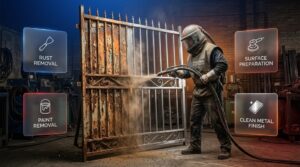
Yes, and on mixed projects it is often the sensible approach. A building might have steel or ironwork that genuinely needs an abrasive to remove rust and create a coating profile, alongside timber that needs soda blasting to preserve the surface. The methods are matched to the material, not to the project. What should not happen is one method being used across everything for convenience.
Does soda blasting raise the grain?
Only mildly, and mostly through moisture rather than impact. Soda is too soft to cut the grain in the way an abrasive does, but softwood can show light fuzzing, and the water rinse afterwards can raise the grain slightly as the timber takes up moisture. Once the wood has dried properly, a light hand sand resolves it before finishing.
Can you sandblast oak?
Physically, yes, oak is dense enough to withstand it. Whether you should is a different question. Sandblasting oak erodes the softer grain, rounds off crisp edges, and removes hand tool marks permanently, so on beams, frames, and joinery where the surface matters, soda blasting is almost always the better choice. Sandblasting oak makes more sense where a heavily textured finish is actually wanted, and no historic detail is at risk.
Is soda blasting safe for plants and glass?
Sodium bicarbonate is softer than glass and will not cut it the way mineral abrasive does, which is one reason it is used around windows and glazing. It is not a licence to skip protection; masking is still standard practice, and seals, gaskets, and coated frames need care. For planting, the concern is alkalinity rather than impact: concentrated soda residue can affect soil pH, so beds and plants in the working area should be covered, and the area rinsed down afterwards.
Do you need to strip lead paint first?
You need to test first. If lead is present, it changes the whole approach; containment, controls, operative protection, and waste disposal are all handled differently, and the work is subject to specific legal duties. It is not a job to do yourself or to let an unprepared contractor take on. Any competent blasting contractor will raise lead testing before quoting on an older property, and if nobody mentions it, ask.
Verdict
For timber, soda blasting is the safer method in the great majority of cases. The media is softer than the wood, so it lifts the coating without cutting the substrate, which is exactly what you need on oak beams, period joinery, reclaimed boards,s and fire or mould damage. Its trade-offs- alkaline residue, possible tannin staining on oak, rinsing and drying time, higher media cost- are real but manageable with correct aftercare.
Sandblasting remains the right answer for metal and for the narrow band of timber work where texture is acceptable, and preservation is not the goal. Applied to timber that matters, it removes material you cannot put back.
If you are unsure which category your project falls into, the test patch is the answer. It costs very little compared with the job, and it replaces opinion with evidence before any commitment is made.