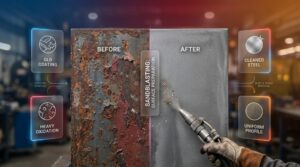
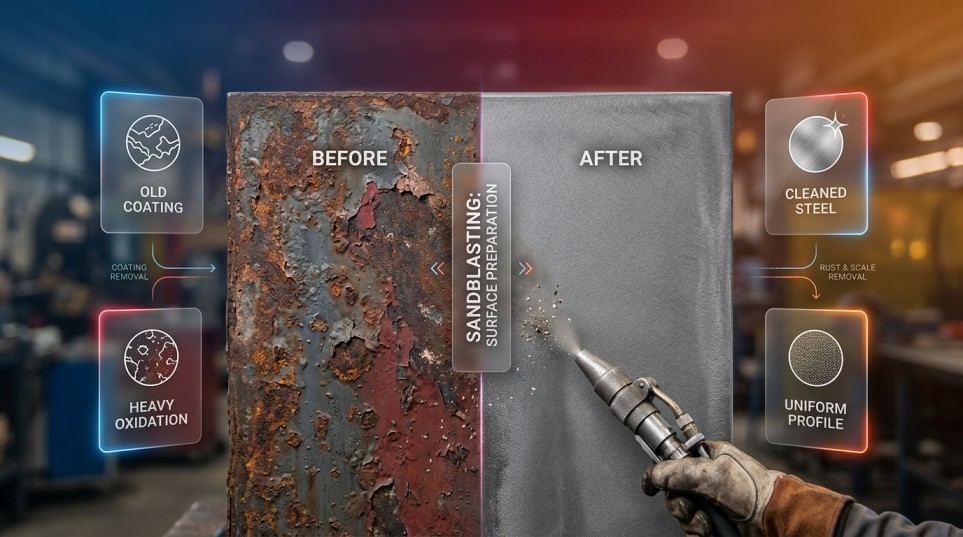
Does sandblasting remove metal? Yes, but when abrasive blasting is properly controlled, the amount of base metal removed is usually very small. A standard blast on sound steel or wrought iron typically removes around 5 to 30 microns (0.005 to 0.030 mm). The actual amount depends on the metal, its condition, the abrasive used, blast pressure, nozzle distance, and how long the surface is worked.
A standard blast on sound metal typically removes around 5 to 30 microns of base metal, which is 0.005 mm to 0.030 mm. That is a fraction of the thickness of a sheet of printer paper. So when people ask how much metal blasting removes, the honest answer is: far less than most people fear, but never quite zero, and the figure moves with the metal, its condition, the abrasive used, and the control of the operator holding the nozzle.
This guide is written for anyone weighing up whether abrasive blasting is safe for metalwork they care about. That might be a rusty wrought iron driveway gate, a set of Victorian railings, a vehicle panel, a piece of cast ornament, or a fabricated steel component. You will find realistic numbers, an explanation of why surface profile is not the same thing as metal loss, the factors that genuinely change how much material comes off, and the situations where blasting really can thin or distort metal. Where a figure depends on the job, we say so rather than dressing an estimate up as a promise.
Does Sandblasting Remove Metal? How Much Is Actually Removed?
Key Takeaways
- A single, properly controlled blast usually takes 5 to 30 microns off sound steel or wrought iron.
- Heavier rust and thicker coatings mean more work at the surface, so more base metal comes away.
- Softer metals such as aluminium give up more material than steel under the same conditions.
- These are typical working ranges, not guaranteed results. Every item is different.
The table below gives the ranges commonly seen when metal is blasted to a clean, coatable standard by an experienced operator. A micron is one thousandth of a millimetre, written as µm.
| Material and condition | Base metal lost in a standard blast | Equivalent in millimetres |
|---|---|---|
| Mild steel, light surface rust | 5 to 15 microns | 0.005 to 0.015 mm |
| Steel or wrought iron, heavy rust and paint | 15 to 30 microns | 0.015 to 0.030 mm |
| Cast iron | 10 to 25 microns | 0.010 to 0.025 mm |
| Aluminium and soft alloys | 20 to 50 microns | 0.020 to 0.050 mm |
| Thin sheet steel panels | 5 to 20 microns | 0.005 to 0.020 mm |
| Galvanised steel with coating removed | 20 to 60 microns of zinc, minimal steel | 0.020 to 0.060 mm |
Read these as a guide to scale, not a specification. Two gates of the same size can sit at opposite ends of the range because one has three flaking coats of old paint over pitting and the other has a thin layer of light surface rust. The numbers also assume the work stops once the surface is clean. Metal loss climbs quickly when an area is worked far longer than it needs.
Why the Loss Is Far Smaller Than Most People Expect
The abrasive spends nearly all of its energy on material that is not sound metal. Paint, primer, mill scale, rust, and general contamination are weaker and more brittle than the parent steel underneath. They shatter and release long before the steel does. For more detail on abrasive blast-cleaning methods, see ISO 8504-2:2019.
Once the operator reaches clean metal, the cutting rate drops sharply. Sound steel resists the abrasive far better than the layers above it, so the last part of the process is mostly about consistency of finish rather than continued removal. A skilled operator recognises that change in the surface and moves on. That single habit is what keeps loss at the bottom of the range instead of the top.
There is a second reason the figures stay low. Angular abrasive does not only cut. It also deforms the surface, pushing metal sideways and upwards as well as knocking particles free. Some of what looks like removal is actually displacement, which we come back to when we look at anchor profile.
Why Rust Removes More Metal Than Blasting Ever Will
Corrosion is the process that consumes your metal. Blasting simply takes away the evidence. When steel rusts, iron from the parent metal is converted into iron oxide. That oxide occupies several times the volume of the steel it came from, which is why rust lifts paint, jacks joints apart, and flakes off in scabs.
So a gate carrying a millimetre of loose rust scale has already lost a meaningful thickness of parent steel to create it. Where corrosion has gone into pitting, the pits themselves commonly run from a few tenths of a millimetre to a couple of millimetres deep on neglected outdoor ironwork. Set that against the 0.005 mm to 0.030 mm taken by a blast, and the comparison speaks for itself.
This is also why a blasted item can look worse before it looks better. The blast does not create that damage. It reveals the damage rust had already done under the paint, which is exactly the information you need before deciding whether to coat, repair, or replace.
What Those Numbers Look Like in Real Terms
Key Takeaways
- One blast removes less metal than the thickness of a sheet of paper.
- The anchor profile left behind is often deeper than the metal lost, which surprises most people.
- Deep rust pitting removes hundreds of times more metal than the blast does.
Microns are hard to picture, so it helps to line the figures up against objects you already know.
| Reference | Approximate thickness |
|---|---|
| Metal removed by one standard blast | 5 to 30 microns |
| Anchor profile left on the surface | 25 to 75 microns |
| A sheet of printer paper | 100 microns |
| A car body panel | 700 to 1,000 microns |
| A wrought iron gate bar wall | 3,000 to 5,000 microns |
| Metal already lost to deep rust pitting | 500 to 2,000 microns |
Two things stand out. First, the blast removes a small fraction of a sheet of paper’s thickness from a gate bar that is thirty to fifty sheets thick. Second, the corrosion that brought you here in the first place has usually taken away far more than the cleaning process ever will.
Why a Sound Gate Can Be Blasted Many Times Over Its Life
Do the arithmetic and the worry usually disappears. Take a wrought iron gate with a 4 mm section, which is 4,000 microns. At the upper end of the range, ten full blast cycles would take off in the region of 300 microns. That is under a third of a millimetre, and it leaves more than ninety per cent of the original section in place.
In practice, exterior ironwork in the UK tends to be stripped back to bare metal and recoated once every ten to twenty years, depending on the coating system, the exposure and how well it is maintained. Most gates will therefore see a handful of blast cycles across a very long service life, not dozens.
One qualification matters here. This arithmetic only holds for metal that is structurally sound. A bar that has already been eaten to half its original thickness by corrosion has a much smaller reserve, and the honest advice on that item may be repair, splicing in new sections, or replacement rather than repeated cleaning.
Surface Profile Is Not the Same as Metal Loss
Key Takeaways
- Anchor profile is a texture, measured from peak to valley. It is not a measure of metal removed.
- Blasting displaces metal upward into peaks as well as cutting valleys, so profile depth overstates loss.
- Profile and thickness are measured in different ways, with different instruments.
This is the single most misunderstood point in the whole subject. People read that blasting leaves a 60 micron profile, assume 60 microns of steel has gone, and conclude that blasting is far more aggressive than it really is. A deep profile does not mean deep metal loss.
What the Anchor Profile Actually Is
The anchor profile, also called the surface profile or surface roughness, is the microscopic peak and valley texture the abrasive leaves behind. It is measured as the vertical distance from the bottom of the valleys to the top of the peaks.
That texture is the whole point of blasting before painting. Coatings grip a roughened surface mechanically, which is why paint systems specify a profile range rather than a polished finish. Typical requirements sit somewhere between 25 and 75 microns, though the correct figure comes from the coating manufacturer’s data sheet for the system being applied, not from a general rule. Too shallow and the coating has little to key into. Too deep and peaks can stand proud of thin coats, giving weak points where corrosion later starts.
Why Profile Depth Does Not Mean Metal Was Removed
Angular abrasives both cut and plough. When a grit particle strikes at speed, part of the metal it displaces is thrown clear, and part is pushed sideways and upwards, forming a raised lip around the impact crater.
The result is that the finished surface has peaks standing above the original surface line and valleys sitting below it. Only the material carried away counts as loss. So a surface carrying a 50 micron profile has generally lost far less than 50 microns of average thickness, because a good share of that measurement is metal that moved rather than metal that left. It is closer to hammering a texture into the surface than to grinding a layer off it.
How Both Are Measured in Microns and Mils
Profile and thickness are separate measurements taken with separate tools. Profile is usually checked against ISO 8503 comparators, with replica tape or with a depth micrometer, all of which read the peak-to-valley height on a small sample area.
Remaining metal thickness is a different question entirely, and where it matters on structural or safety-critical work, it is normally checked with an ultrasonic thickness gauge, which reads through the section without cutting it. On domestic gates and railings, this level of measurement is rarely called for, but the distinction is worth knowing when a specification refers to both.
On units, the UK and Europe generally work in microns while American data sheets often use mils. One mil equals 25.4 microns, so a 2 to 3 mil profile specification is the same as roughly 50 to 75 microns. Mixing the two up is a common source of confusion when reading coating literature.
What Controls How Much Metal Comes Off
Key Takeaways
- Media choice is the biggest single lever, because hardness, shape, and size set how aggressively the abrasive cuts.
- Energy at the surface, distance, angle, and time on one spot all change the outcome.
- There is no universal setting. The approach is matched to the item in front of the operator.
Four variables account for most of the difference between a light, controlled clean and a job that takes off more than it should.
Abrasive Media Type and Hardness
Harder, sharper, and heavier media cut faster and take more base metal. Angular abrasives such as garnet, olivine,e or chilled iron grit slice into the surface and create a sharp profile. Rounded media such as steel shot or glass bead peen the surface instead, which produces a gentler, more dimpled texture.
At the softer end sit media chosen specifically to protect the substrate, including glass bead, plastic media, sodium bicarbonate and agricultural media such as crushed walnut. These remove coatings with far less impact on the metal underneath, though they work more slowly and are not appropriate for every coating or every level of corrosion.
It is also worth knowing that traditional silica sand is heavily restricted in UK workplaces on health grounds because of the risk of silicosis, which is why professional operators here use alternative abrasives even though the trade still uses the word sandblasting. No single medium is right for every job, and the correct choice depends on the metal, the coating being removed, the condition of the surface, the finish required, and how the site can be contained.
Blast Pressure and Abrasive Velocity
Energy at the surface rises steeply with velocity, not gently. Each particle’s kinetic energy is proportional to the square of its speed, so a moderate increase in nozzle pressure produces a much larger increase in impact energy. That is why pressure is the setting most often turned down for delicate work.
Higher energy strips heavy, stubborn coatings quickly and is often the right call on thick structural steel. On thin panels, ornamental castings, aluminium or already pitted metal, that same energy is what turns a clean into damage. Deciding where to sit is a judgement made per item, per media and per condition, which is why you should be wary of any advice that quotes a single pressure setting as correct for everything.
Nozzle Distance, Angle and Dwell Time
Holding the nozzle close, square on, and still is what concentrates energy into one small area. Increasing the standoff distance spreads the blast pattern and lowers the energy any single point receives.
Angle matters as much as distance. Working at an angle across the surface tends to shear coatings off sideways, while a perpendicular strike drives energy straight into the substrate. Dwell time then ties it together. Keeping the nozzle moving spreads the work over a wider area, and pausing in one spot concentrates it. Most of the real damage seen on delicate metalwork comes from time on one spot rather than from blasting as a process.
Repeated Passes Over the Same Area
Metal loss is cumulative, and the passes made after the surface is already clean are pure loss. The first passes are productive because they are removing coating and corrosion. Once bare metal is reached, anything further is taken from the parent material for no gain.
This is where a defined finish standard earns its keep. When the operator is working to a clear, agreed level of cleanliness, there is a point at which the job on that section is finished. Without one, it is easy to keep going in pursuit of a uniform appearance that a pitted old gate is never going to give, and that is exactly how unnecessary thickness disappears.
How Different Metals Respond to Blasting
Key Takeaways
- Steel is the most tolerant. Wrought iron and cast iron need more care, especially where detail or corrosion is involved.
- Aluminium is softer and can be contaminated by ferrous media, so it needs a different approach.
- Blasting galvanised steel removes the zinc, and that protection has to be replaced by the new coating system.
Metals are not interchangeable under a blast nozzle. Hardness, structure, thickness and any protective layer all change how the surface reacts.
Steel, Wrought Iron and Cast Iron
Structural and mild steel handle blasting well, which is why abrasive blasting is the standard preparation before industrial coating systems. Sections are usually generous relative to the loss involved, and the resulting profile is what modern paint systems are designed for.
Genuine wrought iron, the fibrous material used in older gates and railings, behaves differently. It contains slag stringers running through its grain, and where corrosion has worked along those lines, the material can delaminate into layers once the paint and rust are stripped away. The blast does not cause that condition, but it does expose it, and old ironwork should always be assessed with the possibility in mind.
Cast iron is harder and more brittle, often carrying a tough casting skin along with fine moulded detail. Fine detail is the concern rather than thickness. Aggressive work can soften crisp edges on decorative castings, so ornamental cast items usually call for gentler media and lower energy than a plain steel frame.
Aluminium and Soft Alloys
Aluminium is considerably softer than steel and cuts faster under the same conditions, which is why the typical loss range sits higher. It also work-hardens and shows dimpling more readily, so surface appearance can change noticeably.
There is a second issue specific to aluminium. Ferrous abrasive can embed iron particles into the softer surface, and those particles can later cause staining and corrosion under the coating. For that reason, aluminium is normally prepared with non-ferrous media at lower energy, and it should not simply be run through the same setup used for a steel frame.
Thin Sheet Metal and Vehicle Panels
On thin panels, distortion is a bigger risk than thickness loss. A typical car body panel is only around 0.7 to 1.0 mm thick, and the metal removed by a blast is still small against that. The problem is that blasting stresses and heats one face of an unsupported panel.
That stress can pull a flat panel into visible waves, the effect restorers call oil canning, and once a panel has distorted, it takes skilled bodywork to bring it back. Large flat panels, thin fabricated sheet and lightweight infill sections in gates all fall into this category. They can be blasted, but they need a deliberately controlled approach rather than the settings used for heavy sections.
Galvanised and Zinc-Coated Metal
Zinc is much softer than steel, so blasting strips galvanising quickly. A hot-dip galvanised coating is typically several tens of microns thick, and standard abrasive blasting will take it off far faster than it removes the steel beneath. That is why the loss figures for galvanised items are mostly zinc rather than base metal.
The decision to make before starting is whether you want that zinc gone. If the galvanising is sound and you only need to prepare it for overcoating, aggressive blasting is the wrong tool, because it throws away corrosion protection that is still working. If the coating has failed or the item is being taken back to bare metal for restoration, then removing it is part of the job, and the replacement coating system needs to be specified with the loss of galvanic protection in mind. Neither route offers a guarantee against future corrosion. Long-term protection comes from the coating system, the environment, and maintenance, not from the blast itself.
When Blasting Can Genuinely Thin or Distort Metal
Key Takeaways
- Over-blasting is a technique problem, not a property of the process.
- Thin unsupported panels can warp from stress and heat before thickness becomes an issue.
- Where corrosion has already eaten the section, cleaning can expose holes that were hidden under paint.
It would be dishonest to claim blasting can never harm metal. It can, and knowing when tells you what to ask a contractor before work starts.
Over-Blasting and Excessive Dwell Time
Over-blasting is the main way real thinning happens. It comes from holding the nozzle in one place, chasing a uniform appearance on a surface that will never be uniform, or continuing at full energy long after the surface is clean.
It shows itself in localised hollows, softened detail on castings, and a surface that is noticeably rougher in the areas that were worked hardest. The fix is procedural rather than technical, which means matching the media and energy to the item, working to a clear standard, keeping the nozzle moving, and stopping when the section is done.
Heat Build-Up and Warping in Thin Panels
Concentrated blasting builds heat and stress in thin metal, and that combination is what warps panels. The stress comes from thousands of impacts peening one face of a section that has nothing supporting it on the other side.
Experienced operators manage this by spreading work across an area rather than finishing one patch at a time, by keeping the energy down, and by choosing media suited to thin material. This is one of the clearest reasons why panel work and thin ornamental sheet should not be handed to anyone who treats every job as if it were structural steel.
Metal Already Weakened by Corrosion
Where corrosion has thinned a section, the blast can break through, and this is discovery rather than damage. Rust scale and layers of old paint often act as a crust that hides how little sound metal is left underneath, particularly at the bottom of gate frames, in water traps, and at joints where moisture sits.
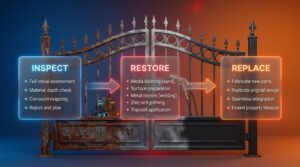
When cleaning opens a pinhole or a soft edge, the material was already gone. What has changed is that you can now see it and plan for it. Depending on the item and where the loss sits, the options usually run from localised welding and letting in new material to replacing a section or, occasionally, accepting that a piece has reached the end of its life. Anyone blasting valuable ironwork should be willing to talk through those outcomes before starting rather than after.
Why Blast Cleanliness Grades Do Not Fix How Much Metal Is Removed
Key Takeaways
- Cleanliness grades such as Sa 2 and Sa 2½ describe visual cleanliness, not depth of metal removed.
- Surface profile sits under a separate standard from cleanliness.
- Two contractors can both hit the same grade and remove very different amounts of metal.
Specifications often call for a blast cleaning grade, most commonly the Sa grades set out in ISO 8501-1, with equivalents in the American SSPC and NACE systems. It is easy to assume that a grade also controls how much material comes off. It does not.
A cleanliness grade describes what the surface should look like when the work is finished, in terms of how much rust, scale, and old coating may remain. It says nothing about the route taken to get there. The metal actually removed depends on how much corrosion and coating had to come off, the media used, the energy applied, and how disciplined the operator was about stopping.
Surface profile is covered separately again, under ISO 8503, and a job can meet a cleanliness grade while sitting outside the profile range the coating manufacturer wants. That is why a good specification for valuable metalwork addresses cleanliness, profile,e and the approach to be used, rather than a grade alone.
The practical takeaway for a customer is simple. A grade in a quote tells you the intended finish, not how carefully your item will be treated. The questions that matter alongside it are what media will be used, how the energy will be adjusted for your metal, and what happens if corrosion turns out to be worse than it looks.
Blasting Delicate and Valuable Metalwork in Reading
Key Takeaways
- Older Berkshire properties often carry ironwork worth restoring rather than replacing.
- Assessment before blasting is what keeps metal loss to the minimum the job requires.
- Old paint layers on pre-1990s ironwork may need controlled handling, which is not DIY work.
Around Reading and the wider Berkshire area, a lot of the metalwork that comes in for blasting is older than the property owner realises. Victorian and Edwardian railings, cast balcony panels, estate fencing and heavy wrought iron driveway gates were all built to last, and in most cases the frame is still worth restoring long after the paintwork has failed.
That is the context in which the metal loss question really matters. Nobody worries about a few microns on a skip full of scrap. People worry when the item is original to the house, hard to replace, or expensive to have remade. At Blastec Sandblasting Services, we handle this kind of work regularly, including wrought iron and driveway gate blasting, railings and fencing blasting, and the approach to an ornate gate is not the approach used on a steel beam.
Why Assessment Before Blasting Prevents Unnecessary Metal Loss
Looking at the item first is what decides the media, the energy, and the finish, and that decision is what protects your metal. An assessment before work starts covers the ground that generic advice cannot.
In practice,e that means identifying what the item is made of, since genuine wrought iron, cast iron and modern mild steel do not behave the same way. It means judging how far corrosion has gone, particularly at the base of posts and in water traps. It means checking for filler, previous repairs and hidden weld work that will appear once the paint is off. On older ironwork it also means considering the paint itself, because lead-based coatings are common on pre-1990s work in the UK and are controlled work that should never be stripped by an untrained person at home.
It is also the right moment to agree on what happens if the metal turns out to be worse than expected. Knowing in advance whether you want repairs quoted, whether a section can be let in, and what your budget allows removes the awkward conversation halfway through a job. If you are weighing up restoration for a gate or railings, our sandblasting and surface preparation services start from that assessment rather than from an assumption.
Useful questions for any contractor you consider include: what media would you use on this metal and why, how do you adjust for thin or ornamental sections, what finish standard are you working to, how is dust and spent abrasive contained on site, how quickly does the bare metal need to be primed afterwards, and what would you recommend if corrosion has gone further than it looks?
Conclusion
For most sound metalwork, blasting removes a genuinely small amount of material. Somewhere around 5 to 30 microns on steel and wrought iron, a little more on aluminium and soft alloys, and mostly zinc rather than steel on galvanised items. Set against a gate bar several millimetres thick, that is a fraction of the section, and far less than the corrosion sitting on the surface has already taken.
The risks that do exist are real but specific. Over-blasting, excessive dwell time on one spot, thin unsupported panels, and metal already weakened by corrosion are the situations where care matters most. Each of those is managed through media selection, controlled energy, sound technique, and an honest look at the item before anyone picks up a nozzle.
If you have a gate, a set of railings or another piece of metalwork you are unsure about, the sensible next step is to have its condition assessed and the right approach agreed before any work is booked. You are welcome to contact Blastec Sandblasting Services in Reading to talk through your item, the condition it is in, and what preparation it realistically needs.