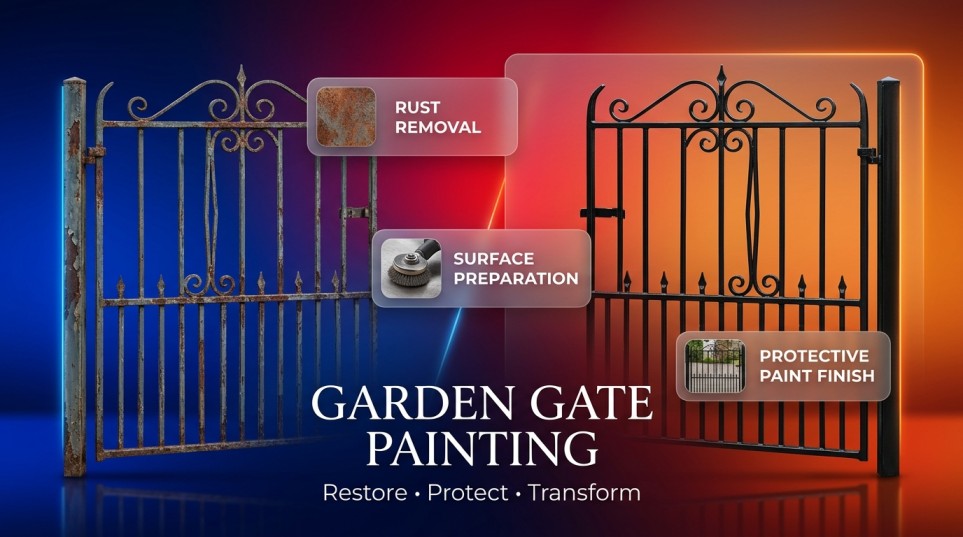
Push open a gate with flaking paint and rust bleeding through the hinges, and it drags down the whole look of your home’s entrance. Garden gate painting fixes that, but only when the prep underneath is right. This guide walks through the full process: cleaning, stripping old paint and rust, priming and painting, for wood and metal gates alike. You’ll also find paint picks and colour ideas that suit a UK garden. Most guides only cover one material. This one covers wood and metal gates together, since many driveways have a mix of both.
Garden Gate Painting: A Step-by-Step Guide
Painting a garden gate well comes down to four stages: clean, strip, prime, paint. Skip a stage and the new coat tends to fail early, often by lifting at the bottom rail or along a weld. Here’s how to paint a garden gate the right way, from first look to final coat.
Before you start: identify your gate and gather your tools
First, work out what you’re dealing with. Wooden gates are usually softwood, oak or a hardwood like iroko or cedar. Oak needs a blocking primer to stop its natural tannins staining through the topcoat. Softwood benefits from a knotting solution over any resinous knots. Metal gates are most often mild steel or wrought iron, though galvanised and aluminium gates turn up too and need their own prep (more on that below).
For either material, gather:
- Brush, roller or sprayer
- Sandpaper in 80, 120 and 240 grit
- Wire brush
- Sugar soap or a general degreaser
- Dust sheets and masking tape
- Primer suited to the gate’s material
- Outdoor paint
- Gloves, a dust mask and goggles
Step 1: Clean the gate first
Remove loose dirt, algae and any flaking paint. Then wash the gate down with sugar soap, and let it dry fully before you touch sandpaper or a brush to it. Grease is a common reason a repaint fails early. Give the gate a second pass with degreaser if it sits near a road or driveway, where oil and traffic grime build up.
While you’re cleaning, check the gate is actually sound enough to repaint. On wood, push a screwdriver gently into the stiles, the bottom rail and the joints. If it sinks into soft, spongy timber, that’s rot. On metal, press a screwdriver against the bottom rail. If it pushes through, that’s rust gone right through the metal, not just surface corrosion. Either finding means a repair job, not just a repaint, so it’s worth knowing before you go further.
Step 2: Strip the old paint and rust
For small patches and light flaking, hand sanding and wire-brushing often does the job. On wood, sand with the grain starting at 80 grit and working up to 120. On metal, work a wire brush and coarse wet-and-dry paper over the rust and loose paint. Feather the edges where sound paint remains, so the new coat doesn’t show a ridge. A chemical stripper is worth trying too if the old paint is thick or heavily built up.
When DIY stripping isn’t enough: if the gate only has light flaking, a single old coat, or surface rust, hand tools will get you there. But thick or peeling layers, heavy rust or pitting, and scrollwork too fine to sand by hand are different. So is a gate you plan to have powder-coated afterwards. In those cases, professional garden gate sandblasting is the more reliable route.
Low-pressure blasting on timber protects the grain while stripping old paint and varnish. Shot blasting on metal cuts through rust, flaking paint and corrosion, back to a clean, keyed surface that gives new paint something solid to bond to. If you’ve been wondering where you can get your garden gates stripped professionally, this is exactly the kind of job a specialist blasting service handles.
A safety note: older gates may have been painted with lead paint at some point. Don’t dry-sand old outdoor paint. It can release lead dust into the air. Wet-flat it instead, use a chemical stripper, or have it stripped professionally. Wear a mask, goggles and gloves whatever method you choose.
Step 3: Repair and prime before you paint
Fill small holes and tighten any loose joints before priming. On timber, use an outdoor two-part wood filler rather than an indoor filler, which tends to shrink and crack after its first wet winter outdoors.
Priming rules worth following:
- Wood: use an outdoor wood primer, add a knotting solution over any knots, and use a blocking primer on oak to stop tannin staining. Give the end grain extra primer too. That covers the top and bottom of the stiles, and the underside of the bottom rail, since rot often starts there.
- Metal: use a red oxide or zinc phosphate primer on bare steel and over welds. A direct-to-rust paint can work over firm, adhered rust or sound old paint, but not on bare shiny steel, fresh welds or newly galvanised metal. Galvanised gates need a mordant wash (T-Wash) or an etch primer, or at least six months of weathering, before paint will grip well.
Either way, don’t paint directly onto bare metal or bare wood without a primer first. It’s the step most often skipped, and the one most likely to shorten the life of the finish.
Step 4: Paint the gate
Weather matters more than most people expect. Aim for a surface and air temperature above 10°C, humidity below around 85%, and no rain forecast for at least 24 hours (some paints call for 48 hours). Avoid damp, cold or frosty conditions, painting in hot direct sun, and starting while morning dew is still on the gate.
On wood, thin the first coat slightly and brush along the grain, building up to two full coats with a light 240-grit sand in between. If you can take the gate off its hinges, paint all faces, including the top and bottom edges, before rehanging it.
On metal, keep coats thin and watch for drips collecting on bars and scrollwork. A brush suits flat rails, while a sprayer is often easier for spindles and decorative scrollwork. Just mask off anything nearby, since overspray travels further than it looks. Paint the fine areas first with a small brush, then move on to the flat sections.
Mask the hinges, latch and lock barrel before you start, and keep paint off the hinge pins and keyway. Once you’re done, leave the gate open for at least 24 hours so the paint cures fully and doesn’t stick to the latch or frame when you close it.
Common mistakes to avoid:
- Painting over rust, grease or flaking paint instead of removing it first
- Applying one thick coat instead of two thin ones
- Painting bright, new galvanising without any prep
- Ignoring the bottom rail, where rot and rust often start
- Painting in cold, damp or hot sun
- Closing the gate before the paint has fully cured
Best Paint for a Garden Gate: Wood vs Metal
Here’s how wood and metal gates stack up at a glance, before the detail below.
| Wood | Metal | |
|---|---|---|
| Primer needed | Outdoor wood primer, plus a knotting solution on knots and a blocking primer on oak | Red oxide or zinc phosphate primer on bare steel and welds |
| Best paint type | Outdoor wood paint, fence-and-gate paint, or a microporous stain | Direct-to-metal paint with built-in rust protection |
| Typical lifespan | 2 to 5 years, depending on the finish | 8 to 12 years, depending on the product |
Best paint for wooden garden gates
Look for an outdoor wood paint or a dedicated fence-and-gate paint with a flexible finish that can move with the timber as it expands and contracts. Water-based options dry quickly, have low odour and stay flexible, which suits a gate that flexes with the weather. Solvent-based gloss or satin finishes dry harder and glossier, but can turn brittle over time on moving timber.
A microporous stain is another option. It lets the wood breathe, is easy to top up without a full strip-back, and keeps a more natural look than a solid paint. Sadolin and Sikkens are commonly used for stain finishes, and Johnstone’s and International both make microporous gate and fence paints. These are examples of the type, not a recommendation of one brand over another.
Best paint for metal garden gates
For wrought iron or mild steel, a direct-to-metal or outdoor metal paint with built-in rust protection is the usual choice. Hammerite’s Direct to Rust range (around £21.30 for 750ml at the time of writing, with claims of around eight years’ protection) is a long-standing option in a smooth black finish. Hammerite Ultima is a water-based alternative (around £14.50), with a claimed protection period of up to 12 years. For wrought iron specifically, Zinsser AllCoat Exterior over a Cover Stain primer is another combination worth knowing. Prices and protection claims are examples at the time of writing, not a quote for your gate. Real-world lifespan depends on exposure, and on how well the surface was prepared beforehand.
Powder coated garden gates
Powder coating is the most durable finish available for a metal gate, with a typical lifespan of 15 to 25 years compared with 3 to 5 years for painted finishes (source: SprayTech Harlow’s powder-coating guide). It only works well on a surface that’s been fully stripped back first. That’s why sandblasting or shot blasting often comes before powder coating, rather than after. Any trace of old paint, rust or dirt left on the metal will show through, or it will shorten the coating’s life.
Garden Gate Paint Colours
Classic black or off-black, white, sage green, navy or Stiffkey Blue, slate grey and heritage green cover most of what suits a UK front garden. Dark colours hide everyday dirt and hand marks well. Light colours show up rust bleed-through on metal gates sooner, and need more upkeep to stay looking clean.
Matching the gate to the house is often the simplest way to choose. Sage or heritage green suits a cottage or country-style home. Black works well against period brick, and slate grey sits well against a rendered or modern front. Farrow & Ball, Cuprinol Garden Shades and Ronseal all offer ranges in these tones. They’re useful for colour inspiration, not a shopping list.
Thinking about the bigger picture for your entrance? Get in touch with Blastec to talk through your gate’s condition before you commit to a colour. It’s worth knowing whether paint alone will do the job before you pick a shade.
How Long Will a Repainted Gate Last?
On wood, a stain finish typically lasts 2 to 3 years before it needs topping up, while a gloss finish with good prep can run 3 to 5 years. On metal, direct-to-rust paint is generally good for around 8 years. Water-based metal paint on well-prepared metal can reach up to 12 years. Neither finish survives being left unchecked, though.
A quick autumn check each year, an annual wash, and touching up chips as soon as they appear (before rust or rot gets a foothold) will do more for a gate’s life than almost anything else.
If the gate itself is warped, dropping on its hinges, badly rusted through or rotten at the joints, paint is only ever a cosmetic fix. In that case, it’s worth weighing up restoring the gate against replacing it. Find out what a full metal garden gate restoration involves before you spend time on a repaint that won’t hold.
FAQs
Do I need to strip old paint before painting a garden gate?
Yes, if it’s peeling or flaking anywhere. Painting over loose paint just gives the new coat something unstable to sit on, and it will peel again in roughly the same spot.
How do I repaint an old garden gate?
Clean, strip, prime, then apply two thin coats. Skipping or rushing any one of those four steps is the most common reason a repaint doesn’t last.
Where can I get my garden gates stripped?
A sandblasting service can strip paint and rust back to bare metal (or clean timber back without damaging the grain) more thoroughly than hand tools manage on a heavily built-up gate. See the garden gate sandblasting service page for details.
What’s the best paint for a wooden garden gate?
An outdoor wood paint or fence-and-gate paint made for garden timber, applied over a suitable primer first, rather than straight onto bare wood.
Can a rusty metal gate be saved, or should I replace it?
If the structure is still sound, stripping back and repainting (or powder-coating) often saves it, rather than requiring a full replacement.
Can I paint a galvanised gate?
Yes, but only after a mordant wash (T-Wash) or an etch primer, or after the galvanising has weathered naturally for six months or more. Paint applied straight onto bright, new galvanising won’t grip, and it will peel.