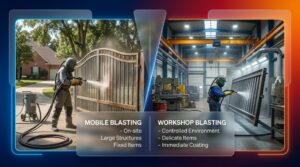
Some blasting companies bring their equipment to your property. Blastec does not. Every job we take on is sandblasted in our own workshop at Cross Lane, Grazeley, just south of Reading. If you are comparing mobile or workshop blasting, this guide explains why we chose the workshop route, what it means for your gates, wheels, furniture or vehicle parts, and how to get larger or fixed items to us.
Key takeaways
- Blastec is a workshop-only sandblasting company. We do not offer mobile or on-site blasting.
- Indoors, the weather never stops the job, dust and abrasive are contained, and bare metal stays dry until it is coated.
- A workshop lets us turn items over and reach every face, so hidden rust on bottom rails, hinges and inside edges is not missed.
- Gates, railings, wheels, radiators, furniture, chassis, trailers and most fabricated steel can be taken down or driven in and blasted with us.
- If your item truly cannot be moved, we will tell you honestly rather than take on a job we cannot do well.
Mobile or Workshop Blasting: Why We Chose the Workshop
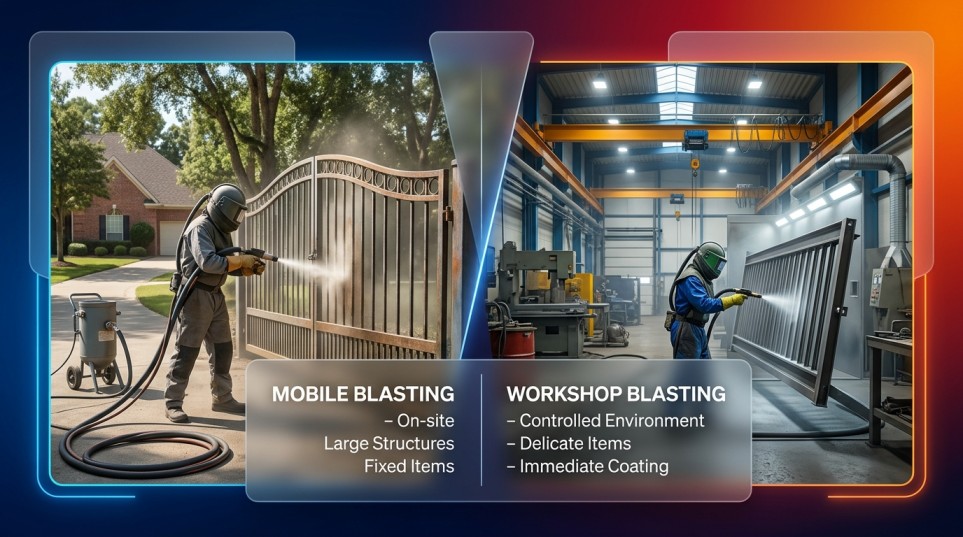
Mobile blasting sounds convenient, but in the UK it comes with real limits. Rain, damp and cold stop work or spoil the result. Dust and spent abrasive are hard to contain on a driveway. Neighbours, cars, windows and planting all need protecting. And an item fixed to a wall or post can only be reached from one or two sides.
We decided early on that we would rather do one thing properly. By keeping every job in our workshop, we control the pressure, the abrasive and the conditions, and we give every customer the same clean, even finish, whatever the weather is doing outside.
What a Workshop Gives You That a Driveway Cannot
No Weather Delays
Outdoor blasting work is often cancelled from late autumn to spring because primers and paints need a dry, warm surface. Indoors, your booking is not at the mercy of the forecast, which matters if you are working to a fitting date, an MOT or a painter’s schedule.
Bare Metal Stays Clean Until It Is Coated
Freshly blasted steel is clean, rough and chemically active, so it reacts with moisture in the air quickly. Outdoors, a light orange bloom of flash rust can appear within hours in damp conditions. Indoors, the same surface stays stable for much longer, giving you time to collect it and get primer or powder coating on. You can read more in our guide on how long sandblasted ironwork lasts before it rusts.
Dust and Abrasive Are Contained
Sandblasting produces airborne dust, spent abrasive and old paint debris. In a workshop this is kept within a purpose-built space instead of drifting onto your car, your windows, your garden or your neighbour’s property. That also matters for older ironwork, where pre-1990s paint may contain lead and needs handling with care.
Every Face of the Item Can Be Reached
On a bench, stand or trestles, an item can be turned over, stood up and worked from every angle. A gate still hanging on its posts can only be blasted from two faces, and the top edge, bottom rail and the back of the hinge plates are exactly where moisture sits and rust starts. In the workshop, those areas get the same attention as the parts you can see.
Seeing the whole item bare also tells you what you are dealing with. Hidden rot, old weld repairs, thinning sections and filler usually only show once the coating is off. Finding them in the workshop, before coating, is far better than discovering them after the item is back in place.
The Right Abrasive and Pressure for Each Item
No single abrasive suits every job. In the workshop we can change the abrasive and lower the pressure between items, and test a small hidden area first. That matters most on:
- thin or decorative wrought ironwork, where too much force can distort scrollwork or lose detail
- aluminium and alloy wheels, which behave differently to steel
- cast iron radiators and other items with hidden internal sections
- timber doors, where gentle settings clean the surface without tearing into the grain
- items with chrome, brass, glass or rubber parts that need masking or removing first
What We Blast in Our Workshop
Most items people assume need mobile blasting can actually be taken down or driven in. The table below shows the jobs we are asked about most often and how they reach us.
| Item | How it gets to our workshop |
| Gates on hinge pins or bolted brackets | Lifted off and brought in |
| Railings and fence panels | Unbolted or cut free by your fitter and brought in |
| Alloy and steel wheels | Dropped off, tyres removed |
| Cast iron radiators | Drained, removed and dropped off |
| Car chassis, subframes and body shells | Brought in on a trailer or transporter |
| Trailers and horseboxes | Towed in |
| Garden furniture | Dropped off |
| Wooden doors | Taken off and brought in |
| Fabricated steel and machinery parts | Delivered by van or lorry |
For larger commercial jobs such as tankers, trailers and vehicle chassis, see our commercial sandblasting service.
Getting Fixed Items Off and Back On
For anything fixed in place, the main question is how easily it can be removed. A few patterns hold true:
- Items on simple hinge pins or bolted brackets usually come off quickly and cheaply.
- If an item has to come off anyway for welding, repair or rehanging, blasting it at the same time adds very little.
- Items welded, cemented or set into masonry may need a fabricator or builder to remove and refit them. It is worth getting their price alongside ours.
- Old wrought iron can be brittle at the joints, and seized hinges can crack a casting if forced. Ask a fitter who knows older ironwork to do the removal.
If you are taking driveway gates down, plan for the opening being unsecured while they are away. Our guide to what happens to gate hinges and locks during blasting explains how fittings are protected.
If Your Item Cannot Be Moved
Some things genuinely cannot come off, such as railings leaded into old stonework or structural steel that holds up a building. Because we only work in our workshop, these are not jobs we take on. We would rather tell you that honestly at the start than offer a compromise we cannot stand behind. If you are not sure whether your item can be removed, send us a photo of the fixings and we will give you a straight answer.
Workshop Sandblasting for Reading and Berkshire
Customers bring work to us from across Reading, Wokingham, Bracknell, Newbury, Basingstoke, Maidenhead, Slough and the wider Berkshire area. Our workshop is at Cross Lane, Grazeley, Reading RG7 1JJ, and we are open Monday to Friday, 8am to 4pm.
To get a price, send a few photographs of the item, a close-up of any fixings and rough sizes. You can see what typical jobs cost in our sandblasting prices guide, and how long they take in our turnaround times guide.
Conclusion
Mobile blasting has its place, but it brings weather delays, dust problems and limited access that make a consistent finish hard to guarantee. That is why Blastec only sandblasts in its own workshop. Most items, from gates and wheels to trailers and chassis, can be taken down or driven in, and they get a cleaner, more thorough result for it.
Call 07432 652243 or email blastec.reading@gmail.com with photos of your item, and we will tell you how to get it to us and give you a clear, fixed quote.