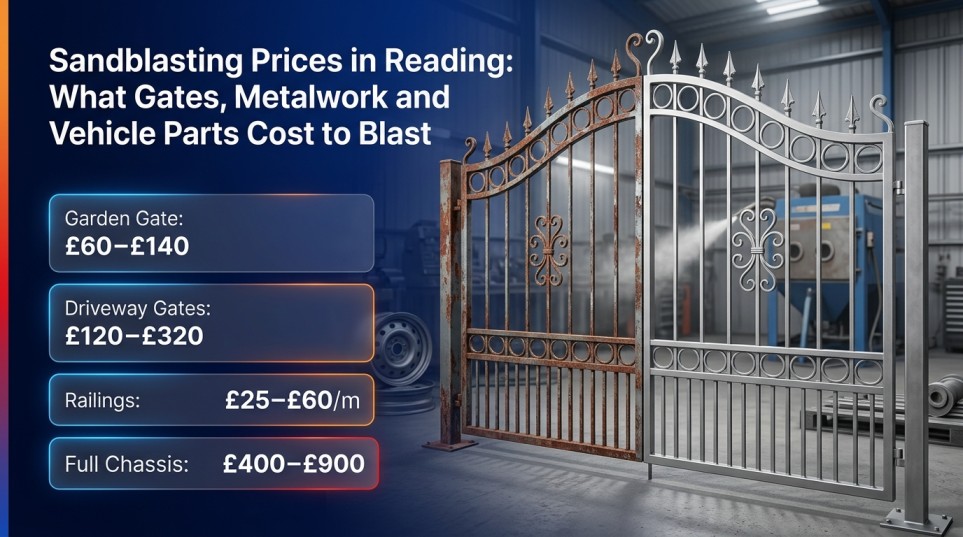
Most domestic sandblasting jobs in Reading fall between £60 and £320. A single garden gate sits near the bottom of that band, a pair of ornate driveway gates near the top, and larger vehicle work such as a full chassis runs higher again. The figures in this guide are typical UK benchmark ranges, not fixed quotes; what you actually pay depends on how long the item takes to blast back to a sound surface.
That last point is the one most price lists hide. Blasting is priced by time and difficulty, not by weight or by how big something looks in a photograph. Two gates of the same height can be an hour apart in the booth if one is a plain box section and the other is covered in scrollwork, finials and forty years of layered paint.
This guide is written for homeowners and property owners around Reading and the wider Berkshire area who are weighing up whether to restore or replace a rusty gate, a set of railings, a radiator, a motorcycle frame or a chassis. It explains how blasting work is priced, what each type of item usually costs, and what to send a blasting company so the quote you get back is accurate.
Before you read the tables, five things worth knowing:
- Price follows blasting time, surface condition, and access; surface area alone is a weak guide.
- Small items are usually quoted per item, gates and vehicle parts per hour, railings and fencing per metre.
- Gentler methods such as soda blasting cost more per item because they remove coatings more slowly.
- Most quotes cover blasting only. Primer, paint and powder coating are normally priced separately.
- A clear photo set and rough dimensions will get you a firm price far faster than a written description.
Sandblasting Prices Reading at a Glance
The table below gives typical UK price bands for the items blasting companies are asked about most often. Treat them as a planning range for budgeting and for sense-checking a quote, not as a price list.
| Item | Typical UK price | Benchmark basis |
| Single alloy or steel wheel | £15 – £55 (avg £35) | Checkatrade UK average |
| Set of four wheels | £100 – £180 | Usually discounted from per-wheel |
| Motorcycle frame | £90 – £180 | By complexity and bracketry |
| Cast iron radiator | £80 – £200 | Small-item band |
| Single garden or side gate | £60 – £140 | 1–2 hours at UK blast rates |
| Pair of driveway gates | £120 – £320 | 2–4 hours, ornate at higher end |
| Railings and fencing | £25 – £60 per metre | By decorative detail |
| Car body panel | £60 – £150 | Per panel, lower pressure on thin steel |
| Full chassis or subframe | £400 – £900 | By size and corrosion |
| Garden furniture set | £120 – £300 | By number of pieces |
| Wooden door | £35 – £90 | Timber band, gentler media |
The prices above are indicative benchmarks rather than fixed quotes. For additional context, compare them with this guide to typical UK sandblasting costs, which covers common items such as wheels, radiators and vehicle components.
What Most Domestic Jobs Actually Cost
Strip out the outliers, and the picture gets simpler. The majority of household enquiries for sandblasting services in Reading are single gates, pairs of gates, railings, radiators and garden furniture, and almost all of those land somewhere between £60 and £320.
Vehicle work splits into two very different groups. Wheels, panels and motorcycle frames are small-item work and are priced accordingly. A full chassis or subframe is a different job altogether: more surface area, more hidden corners, heavier corrosion, and often a need to work around brackets and seams.
It is also worth separating the blasting figure from the total project cost. Blasting is one stage. If the item then needs primer, paint, galvanising or powder coating, that is a second cost from either the same company or a coating specialist, and it is often the larger of the two on decorative metalwork.
Why Two Items of the Same Size Can Be Priced Differently
Surface area tells a blaster how much ground there is to cover. It says nothing about how hard that ground will be to clear. Four factors routinely pull two similar-looking items into different price bands:
- Coating history. A gate with one layer of flaking primer clears quickly. A gate with six decades of gloss, Hammerite, and touch-ups over the top needs repeated passes.
- Rust severity. Light surface rust lifts with the coating. Deep pitting means working into each pit, which is slow and detailed work.
- Shape and detail. Flat panels are quick. Scrollwork, twisted bars, lattice, hinges, and lock housings all have to be worked from several angles.
- Access and handling. An item that can be lifted onto a bench takes less time than one that must be propped, turned, and re-rigged partway through.
Two gates with identical dimensions can therefore be an hour or more apart, and that hour is what shows up as a price difference on the quote.
How Blasting Work Is Priced: Per Item, Per Hour or Per Metre
Blasting companies use three pricing models, and which one you are quoted on tells you something useful about how the job will be handled. Understanding the model is the difference between comparing two quotes properly and comparing two numbers that were never measuring the same thing.
Per-Item Pricing for Wheels, Radiators and Furniture
Items that arrive in predictable sizes get a flat price. Wheels, radiators, chairs, tables, motorcycle frames and single panels all fall into this group, because a blaster has handled enough of them to know roughly how long each takes.
Per-item pricing usually comes with volume discounts. A set of four wheels is typically cheaper than four times the single-wheel price, because setup, masking and media changeover happen once rather than four times. The same logic applies to a matching set of garden furniture.
The band still has a top and a bottom. A clean alloy wheel with factory lacquer sits near the bottom. A steel wheel with heavy corrosion inside the rim and old wheel-weight adhesive sits nearer the top.
Hourly Pricing and What an Hour of Blasting Covers
Gates, architectural metalwork, chassis, and anything unusual are more often priced by the hour, or quoted as a fixed price that was worked out from an hourly estimate. This is the honest model for items where condition cannot be judged until work starts.
An hour of blasting is not an hour of continuous nozzle time. A realistic hour includes positioning and securing the item, masking fixings and bearings that must stay clean, blasting, repositioning to reach the other faces, and a check over the cleared surface before the item is moved on. Media handling and workshop clean-down sit inside the charged time too.
That is why an item that looks like a thirty-minute job can be quoted at two hours. The nozzle work may genuinely be short. The handling around it is not.
Per-Metre Pricing for Railings and Fencing
Railings, fence panels and balustrades are usually priced per linear metre, because that is how they are built and how they are measured on site. The typical band runs from around £25 per metre for plain vertical bars to around £60 per metre for decorative work.
What moves a run up that scale is the number of surfaces per metre. A railing with closely spaced bars, horizontal rails, decorative panels and spear tops has several times the real surface area of a plain run of the same length, and every face has to be reached.
How to Work Out a Rough Figure Before You Call
You can get within a sensible range yourself before speaking to anyone:
- Measure the item. Width and height for gates, total length for railings, and a count of individual pieces for furniture or wheels.
- Place it in the table above. Start at the midpoint of the relevant band rather than the bottom.
- Adjust for detail. Ornate scrollwork, lattice, spear tops, or complex bracketry push the figure toward the upper end.
- Adjust for condition. Flaking paint and light surface rust sit mid-band. Deep pitting, multiple coating layers,s or previous powder coating sit higher.
- Add the next stage. If the item needs protecting afterwards, budget for primer and paint or for powder coating as a separate line.
A figure built this way is a budget, not a quote. It is enough to decide whether restoration is worth pursuing against the cost of replacement, which is usually the real question behind the search.
Prices for Gates, Railings and Architectural Metalwork
Gates and railings are the most common domestic blasting enquiry in and around Reading, and they are also where the price range is widest. A plain side gate and an ornate Victorian driveway pair are both “a gate” to a search engine. They are nothing alike in the workshop.
Metal and Wrought Iron Gate Blasting Prices
A single garden or side gate typically costs £60 to £140 to blast, reflecting one to two hours of work at common UK rates. A pair of driveway gates typically costs £120 to £320, with two to four hours of work and the ornate examples at the upper end.
What sits inside those numbers:
- Plain box-section or railing-style gates clear quickly and tend toward the lower half of the band.
- Traditional wrought iron with scrollwork takes longer, because each curl and joint has to be worked from more than one angle.
- Gates with cast or decorative inserts add time again, and sometimes need a change of approach where thinner cast detail sits alongside heavier frame steel.
- Previously powder-coated gates can be slower than painted ones. A sound powder coating is a tougher film to break than old gloss.
For a fuller breakdown of how gate work is assessed and handled, see the gate sandblasting service page.
One practical point for anyone comparing restoration against replacement: blasting reveals the true condition of the metal underneath. Where a gate has corroded through at the bottom rail or a joint has failed, that will be visible once the coating is off, and any welding or section repair is separate work with its own cost.
Railings, Fencing and Balustrade Prices
Railings and fencing are quoted per linear metre, typically £25 to £60 per metre depending on decorative detail. A 10-metre run of plain railings therefore sits in a very different place from a 10-metre run of spear-topped Victorian railings with decorative panels.
The variables that matter most on a railing quote are bar spacing, the number of horizontal rails, whether there are finials or spear tops, and whether the run includes gate posts or newels. Balustrades add handrail detail and often sit at the upper end for the same reason.
Access changes things too. Railings that are still fixed to a wall or set into a path either need on-site blasting with containment, or need removing, transporting and refitting. Both routes have a cost, and they are rarely the same. The railings sandblasting page sets out how those options differ in practice.
Why Ornate and Heavily Rusted Metalwork Costs More
The two things that most reliably raise a metalwork price are detail and corrosion, and they compound each other.
Detail increases the real surface area while reducing the speed at which it can be covered. A blast nozzle works most efficiently on an open face at a consistent standoff. Scrollwork forces constant repositioning, shorter working passes, and more checking, and it creates pockets where old coating sits protected from a straight-on pass.
Heavy corrosion adds passes. Pitted steel holds rust inside each pit, and clearing it means working the surface until the pits are sound rather than until the item simply looks clean. On badly pitted metalwork, this can double the blasting time compared with a sound surface of the same size.
It is worth being realistic about the outcome here. Blasting removes rust, corrosion products and old coatings from the surface, which is the necessary preparation for a new coating system. It does not replace metal that has already been lost, and it does not by itself stop corrosion returning; that depends on the coating applied afterwards, how soon it goes on, and the conditions the item lives in.
Prices for Vehicle and Motorcycle Components
Vehicle work covers everything from a single wheel at £15 to a full chassis at £900, so the category is almost meaningless as a price band. What matters is the thickness of the metal, the coating on it, and how much hidden area the component has.
Alloy and Steel Wheels
A single alloy or steel wheel typically costs £15 to £55, with a UK average around £35. A set of four usually comes in at £100 to £180 rather than four times the single price.
Wheels are straightforward in principle and fiddly in practice. The face is quick. The barrel, the back of the spokes and the inner rim take longer, and old balance-weight adhesive, brake dust and corrosion behind the rim lip all have to be dealt with. A wheel quoted as a flat price has usually been priced on the assumption that it is a standard road wheel in ordinary condition.
Two things to flag when you ask for a price: whether the wheels have been previously refurbished or powder coated, and whether tyres and valves are still fitted. Both change the work involved.
Chassis, Subframes and Suspension Parts
A full chassis or subframe typically runs £400 to £900, depending on size and the extent of corrosion. This is the largest single-item job most private customers will ever commission, and the spread reflects genuine uncertainty before the item is seen.
Chassis work is priced high for sound reasons. There is a great deal of surface area, much of it inside box sections, around brackets, mounting points and seams where corrosion concentrates, and access is poor. Heavily corroded sections sometimes need more than one approach, and the work is slow wherever the nozzle cannot reach a surface cleanly.
Blasting a chassis also has an important side effect: it shows you exactly what you have. Corrosion that was hidden under underseal or thick paint becomes visible, and on a restoration project that information arrives before you have spent money on coating. Any repair that follows is separate work.
Body Panels and Motorcycle Frames
Car body panels typically cost £60 to £150 each, and motorcycle frames £90 to £180 depending on complexity and bracketry.
Panels are the most technique-sensitive vehicle work there is. Thin sheet steel carries heat and can distort if blasted too aggressively or for too long in one area, so panel work is normally done at lower pressure with a carefully chosen media, worked in shorter passes. That is slower than blasting heavy section steel, which is why the per-panel price can look high relative to the panel’s size.
Motorcycle frames sit between the two. The tube itself is manageable, but headstocks, engine mounts, brackets, tabs, and welded joints all have to be worked individually, and anything that must stay masked- bearing surfaces, threads, machined faces -adds preparation time before blasting starts.
For restoration projects generally, it helps to separate what blasting does from what it cannot do. It removes coatings and corrosion products to give a clean, keyed surface for the next stage. It does not undo previous damage, fill pitting or return a component to factory condition, and on thin or already weakened metal the right answer is sometimes a gentler method or a different approach altogether.
Prices for Household, Garden and Timber Items
Household items are where blasting most often competes directly with replacement, and where the sums usually favour restoration, particularly for cast iron and solid timber, which are expensive to buy new and hard to match secondhand.
Cast Iron Radiators
Cast iron radiators typically cost £80 to £200 to blast, which places them in the small-item band despite their weight.
The price depends mostly on the number of sections and the style of the column detail. A plain four-column radiator is quicker than an ornate Victorian pattern with decorative faces, and more sections means more internal faces between columns, each of which has to be reached.
Two practical points. First, radiators are normally blasted empty and disconnected, and any valves or fittings that are to be kept need masking. Second, a stripped cast iron radiator is bare metal that will start to surface-rust quickly in normal air, so the coating stage should be arranged to follow blasting closely rather than weeks later.
Garden Furniture, Benches and Tables
A garden furniture set typically costs £120 to £300, priced by the number of pieces rather than by weight.
Cast aluminium and cast iron sets with decorative patterning take longer per piece than plain tubular steel furniture. Slatted benches with timber inserts need the timber removed first, or masked, and that preparation is part of the cost. A set quoted as a single figure usually assumes the pieces arrive together and can be worked as one batch, which is where the saving against per-item pricing comes from.
For furniture that has been repainted several times over the years, expect to sit nearer the top of the band. Layered coatings on fine patterning are slow work.
Wooden Doors and Timber Items
Wooden doors typically cost £35 to £90, using gentler media than metalwork.
Timber is a different proposition from steel, and it is the surface where method matters most. Wood is soft, the grain is uneven in hardness, and aggressive blasting will raise the grain, erode the softer bands between growth rings and round over mouldings and edges. Done at the wrong pressure with the wrong media, the surface is damaged rather than cleaned.
That is why timber work is normally done with a softer media at lower pressure, worked more slowly and checked frequently. The result is paint removal with the character of the timber and its detail retained, but it is a judgement call on each piece, and some doors are better suited to other stripping methods. A blaster who asks what the timber is, how old it is, and how many coats are on it is asking the right questions.
One caution worth stating plainly: paint on pre-1980s UK properties may contain lead. Removing lead-based coatings is not a DIY job and has its own handling and containment requirements, so flag the age of the item when you ask for a price rather than after work has started.
How the Blasting Method Changes the Price
“Sandblasting” is used as a general term for a family of processes, and they are not interchangeable. The method suited to your item affects both the price and what the finished surface will look like, so it is worth understanding before you compare quotes.
Standard Dry Blasting and Dustless Blasting
Dry abrasive blasting is the conventional process: abrasive media propelled by compressed air at the surface. It is efficient on structural steel, gates, railings, chassis, and most robust metalwork, and it is usually the lowest-cost method per item because it clears coatings quickly.
Dustless blasting, sometimes called wet or vapour blasting, introduces water into the abrasive stream. The water suppresses a large proportion of the airborne dust and takes some of the heat and aggression out of the process. That makes it useful for on-site work in built-up areas, for neighbours and parked cars, and for surfaces where a softer cut is wanted.
It is not a dust-free process, and it brings its own considerations: water on bare steel means flash rusting can begin quickly unless the surface is treated or coated promptly, and there is a wet slurry of spent media and removed coating to contain and dispose of. Dustless work is often priced a little above standard dry blasting for the same item because of the setup and cleanup involved.
Soda Blasting and Walnut Shell Blasting for Delicate Items
Soda blasting uses sodium bicarbonate as the media. It is soft enough to remove many coatings without cutting into the substrate underneath, which makes it a candidate for thin panels, aluminium, chrome-adjacent components and items where the metal itself must not be profiled.
Walnut shell and other organic media work on a similar principle, and are often used on timber, delicate castings and components with fine detail that would not survive a mineral abrasive.
Both leave the surface in a different state from a mineral abrasive. A soda-blasted surface is clean but has little or no profile, and soda residue has to be managed before coating, because it can interfere with adhesion if it is not removed properly. Those are the kinds of details worth discussing with the company doing the work and whoever is applying the coating afterwards.
Why Gentler Methods Take Longer and Cost More
The trade-off is consistent across every blasting method: the less aggressive the process, the longer it takes to remove the same coating.
A soft media removing paint without touching the substrate is doing less work per pass by design. More passes, more time, and often more media consumed for the same item. On a component where a mineral abrasive would be finished in twenty minutes, a gentler method might take an hour, and the price reflects that hour.
That extra cost is not waste. On a thin panel, an aluminium casting or a piece of detailed timber, the gentler method is the one that leaves you with a usable item. The judgement sits with the material and its condition, not with a preference for one process over another, and a blaster who proposes the gentler route on a delicate item is protecting the work rather than inflating it.
What Moves the Price Up or Down
If you want to predict where in a band your item will land, these are the factors doing the work.
Surface Area, Material and Coating Thickness
Surface area sets the floor. Material and coating set the rate.
Heavy structural steel takes an aggressive media and clears fast. Thin sheet, aluminium, cast components and timber all need a more controlled approach, which is slower. On top of that sits the coating: a single layer of old primer is a different job from decades of gloss, and sound powder coating or two-pack paint is tougher again than ordinary household paint.
The practical consequence is that a small item with a difficult coating can cost more than a larger item with an easy one.
Rust Severity and How Many Passes Are Needed
Rust is the single biggest unknown in most quotes, and the reason experienced blasters are cautious about pricing from photographs alone.
Light surface rust generally comes off with the coating in the same pass. Pitting is different: the corrosion sits below the original surface line, and clearing it means working each pit rather than the surface as a whole. Scale and flaking layered corrosion need the loose material removed before the sound metal underneath can be reached.
Where a gate or chassis has serious pitting, the honest expectation is more passes and a figure toward the top of the band, or a conversation about whether blasting is the right spend on that item at all.
Mobile On-Site Blasting Compared With Workshop Blasting
Workshop blasting is generally the more economical route. The equipment is set up, the containment exists, lighting and positioning are controlled, and spent media is handled as part of the normal workflow.
Mobile on-site blasting exists for items that cannot practically be moved: railings set into paths, gates on live driveways, structures, and fixed metalwork. It carries additional cost because the work has to be contained where it stands, the equipment has to be brought in and set up, and the site has to be left clean.
For anything that can be removed and transported, it is usually worth pricing both routes. Removal and refitting has a cost, but it is sometimes lower than the containment and setup needed to blast an item in place.
Collection, Delivery and Site Access
Collection and delivery are usually priced separately from blasting, and whether they are offered at all depends on the item, the distance and the company.
Access shapes the figure on mobile work in particular: whether a vehicle can get close to the item, whether there is a power or water supply, whether neighbouring property, cars, windows and planting need protecting, and whether the work can be carried out without restricting access for others. A job in a tight town-centre Reading terrace and the same job on an open rural driveway in Berkshire are not the same job.
Minimum Charges and VAT
Most blasting companies apply a minimum charge, because the setup, media handling and clean-up for one small item are much the same as for several. This is why a single bracket is rarely proportionally cheaper than a wheel, and why it is usually worth sending several small items together if you have them.
On VAT, check what the figure you are given represents. Quotes to private customers are often presented inclusive of VAT, while trade quotes are commonly exclusive, and comparing one of each will make a competitive price look expensive. Ask whether the price includes VAT, and ask the same question of every quote you are comparing.
What a Sandblasting Quote Should Cover
The most common reason two quotes differ by a large margin is that they cover different work. Before comparing figures, check what each one includes. The split below reflects how blasting work is generally organised, though exactly what is bundled varies between companies, so confirm it rather than assume it.
| Usually included | Usually charged separately |
| Blasting back to bare metal | Primer or paint after blasting |
| Masking of fixings and hardware | Powder coating |
| Abrasive media and consumables | Welding or section repairs |
| Workshop labour | Collection and delivery |
| Abrasive waste disposal | On-site containment for mobile work |
| Post-blast surface inspection | Out-of-hours or weekend work |
The second column is where budgets usually go wrong. Coating is a genuine second stage with its own cost, and on decorative metalwork it is frequently the larger half of the project. A gate quoted at £180 to blast and £320 to powder coat is a £500 project, and only one of those numbers appears in a blasting price list.
How to Compare Two Quotes Fairly
Put both quotes side by side and check six things:
- Scope. Does each cover blasting only, or blasting plus a coating? Compare like with like, or the exercise is meaningless.
- VAT. Inclusive or exclusive, on both.
- Method. Standard dry blasting, dustless, or a gentler media? A cheaper quote may be proposing a more aggressive process than your item can take.
- Finish state. What condition is the item handed back in, and is anything applied to hold off flash rusting before you coat it?
- Logistics. Who moves the item, and is that cost in the figure?
- Conditions. Is the price fixed, or an estimate subject to the condition found once blasting starts? An estimate that may change is not dishonest, but it is not comparable to a fixed price.
A quote that is markedly cheaper than the others usually differs on one of those six points. It is worth finding out which before deciding, and worth being wary of any quote that promises a guaranteed outcome on an item nobody has yet seen.
Getting an Accurate Sandblasting Quote in Reading
The ranges in this guide will tell you whether a project is worth pursuing. They will not tell you what your gate costs, because nobody can do that without seeing it.
Blastec Sandblasting Services covers residential and commercial blasting across Reading and the surrounding Berkshire area, including gates, railings and architectural metalwork, vehicle and motorcycle components, cast iron radiators, garden furniture and timber items. A quote is based on the item itself, its size, material, condition and the coating on it rather than on a category average.
What to Send When You Ask for a Price
You will get a firmer figure, faster, if you send this with your enquiry:
- Photographs. A full shot of the item and two or three close-ups of the worst areas. Close-ups of rust, flaking paint, and any damage are the most useful images you can send.
- Dimensions. Height and width for gates, total length for railings and fencing, and a count of pieces for furniture, wheels,s or multiple items.
- Material. Wrought iron, mild steel, cast iron, aluminium, timber, or say if you are not sure, which is common and perfectly fine.
- Coating history. How many times it has been painted, whether it has been powder coated before, and roughly how old the item is. Flag anything pre-1980s in case of lead paint.
- What happens next. Whether you want blasting only, or blasting plus protection, and whether a coating company is already lined up.
- Access. Whether the item can be removed and transported, or whether it has to be blasted where it stands.
- Location and timing. Where in the Reading or Berkshire area the item is, and whether there is a deadline you are working to.
Timing is worth a sentence of its own. Bare blasted steel will begin to surface-rust in normal UK air, so blasting and coating are best planned as one sequence rather than two unconnected jobs weeks apart. If you are coordinating two companies, say so at the quote stage so the handover can be arranged sensibly.
Request a sandblasting quote from Blastec with photos and measurements, and you will get a realistic figure for your specific item rather than a range.
Conclusion
Sandblasting prices in Reading are more predictable than they first appear, as long as you read them the right way. Small items are priced per item, gates and vehicle work by the hour, railings by the metre, and almost every figure moves with condition rather than size. Most domestic work lands between £60 and £320; vehicle restoration work runs higher because there is more of it and more of it is hidden.
For anyone deciding between restoring and replacing, the comparison that matters is blasting plus coating against the cost of a new item of equivalent quality. On cast iron, wrought iron, and solid timber, restoration frequently wins, not only on price, but because the replacement rarely matches what is already there.
What blasting gives you is a clean, sound surface and an honest view of the metal underneath. What happens after that -the coating system, how quickly it goes on, and how the item is maintained- is what determines how long the result lasts.
If you have a gate, a set of railings, a radiator, or a vehicle component you are weighing up, send photographs and measurements to Blastec Sandblasting Services and ask for a quote for your specific item. It takes a few minutes, and it replaces a range with a figure you can actually plan around.