
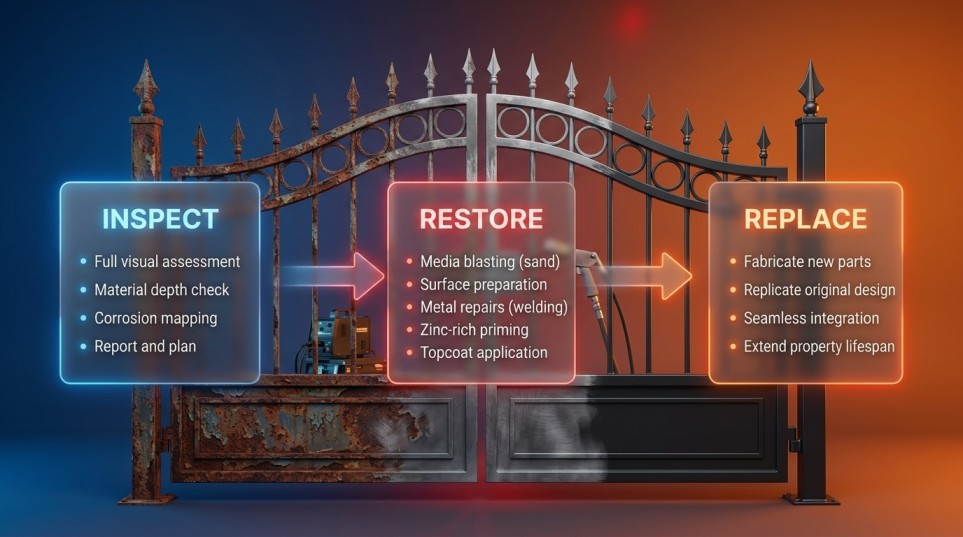
Rust makes a wrought iron gate look finished long before it actually is. In most cases the metal underneath is still sound, and the honest answer to whether you should restore or replace rusty wrought iron gates is that restoration is usually the better decision. The exception is structural loss, meaning holes and heavy thinning in the main frame or in the hanging stile that carries the weight of the leaf. The complication is that layers of old paint and flaking rust hide the true condition of the metal, which is why the most reliable assessment comes after the gate has been blast cleaned back to bare metal.
Key takeaways
- Surface rust, flaking paint and shallow pitting are cosmetic problems. On their own they almost never justify replacing a gate.
- Structural loss changes the answer. Holes through the main frame or hanging stile are the point at which replacement becomes sensible.
- Part of a gate can be repaired without replacing all of it. Bar feet, bottom rails, split collars, bent bars and missing finials are all repairable.
- A sagging gate is often a post or hinge problem. Check what the gate hangs on before you price a new gate.
- Costs move with size, paint build, access and repair scope. Published ranges are a guide, not a quote for your gate.
Restore or Replace Rusty Wrought Iron Gates: The Short Answer
Use the table below as a first sort. It matches what you can see on the gate to what it usually means for the metal, and to the decision that normally follows.
| What you can see on the gate | What it means | Verdict |
|---|---|---|
| Flaking paint and orange surface rust, metal still solid | Cosmetic corrosion only | Restore |
| Rough pitted patches, metal rings solid when tapped | Surface loss without structural risk | Restore |
| Small holes in decorative scrollwork or infill bars | Localised loss, repairable | Restore with section repair |
| Frame bars flex or dent under hand pressure | Significant wall thinning | Blast first, then assess |
| Holes through the main frame or hanging stile | Structural failure | Replace |
| Gate sound but posts crumbling or shifting | Post problem, not a gate problem | Restore gate, replace posts |
| Original wrought iron, Victorian or bespoke design | Rarely worth replacing at any rust level | Restore |
Treat this as a sorting tool rather than a diagnosis. Two gates with identical looking rust can be in very different condition once the coating comes off, which is covered further down.
Why Most Rusted Wrought Iron Gates Are Still Worth Saving
Older gates were built with metal to spare. Frames, hanging stiles and bottom rails were commonly made from far heavier sections than the light steel used in many budget replacement gates today. Corrosion has to remove a great deal of that metal before the gate becomes structurally weak, and most rusty gates are nowhere near that point.
Rust also exaggerates itself. Corrosion products take up several times the volume of the steel they came from, so a bar carrying thick flaking scale usually measures far better than it looks. Strip the scale away and what is left is often a slightly rough but perfectly serviceable bar.
There is a practical argument as well. A gate that already fits its opening, hangs on posts that suit it and matches the piers, railings or fencing around it carries value that a catalogue replacement does not. Replacing it means matching the aperture, re-hanging, possibly altering posts, and living with a design that may not sit well with the property.
How to Judge How Bad the Rust Really Is
You can learn a lot in ten minutes with a torch, a small spanner and a dry day. Work along the gate methodically instead of judging it from the driveway. This is a customer level check rather than a technical inspection, and it stops well short of anything involving power tools or coating removal.
Surface Rust and Flaking Paint
This is the most common condition and the least serious. You will see orange bloom breaking through the paint, blisters lifting in patches and old coating peeling in sheets or curls. Underneath, the metal feels rough but firm.
Layers of paint make things worse rather than better. Every coat applied over existing rust seals moisture against the metal and hides what is happening beneath it. Gates that have been repainted every few years for decades often carry a thick, brittle shell holding damp against otherwise sound steel.
One safety point before you start scraping. Paint on older gates can contain lead, and dry sanding, grinding or burning it off releases it. Coating removal on old ironwork belongs in a controlled blasting setup with proper containment and protective equipment, not in a weekend of DIY.
Pitting and Metal Thinning
Pitting is the next stage. Instead of an even film of rust you find rough craters where corrosion has bitten unevenly into the surface. Run a hand along the bar and it feels like coarse sandpaper with dips in it.
Two simple checks help. First, tap along the bars with something small and metal. Sound metal gives a clear ring, while thinned or heavily corroded metal gives a duller, flatter note. Second, compare the bottom of the gate with the middle. Water sits at the base, so bottom rails, bar feet and the lower ends of stiles corrode first and thin fastest.
Pitting by itself is not a reason to replace a gate. It becomes significant when it is deep enough to have taken real thickness out of a load bearing member, and that is difficult to judge accurately through paint.
Holes and Section Loss in Bars or Frame
Holes change the conversation, but where they sit matters far more than how many there are.
Perforation in decorative scrollwork, infill bars or panel detail is a repair job. Those elements carry very little load, and individual sections can be cut out and remade without touching the structure of the gate.
Holes through the main frame, and particularly through the hanging stile that the hinges bolt to, are far more serious. That upright takes the full weight of the leaf every time the gate swings, and repeated loading on thinned metal is how gates eventually fail.
Be careful with metal that looks solid next to a hole. Corrosion usually spreads under the surrounding paint film, so the sound looking area around a perforation is often thinner than it appears.
Corrosion at Joints, Hinges and Fixings
Joints trap water. Collars, riveted joints, tenons through mortices, welded junctions and the overlaps where bars pass through rails all hold moisture for longer than an open surface does.
Two things follow. The joint corrodes from the inside, and expanding rust forces the components apart, which is why old collars split and rivets work loose. Hinges have their own problems: worn pins, elongated eyes, seized pivots and corroded fixing bolts.
Establish whether the fault sits in the gate or in what holds it. A gate hanging badly because a hinge pin has worn oval is a straightforward fix that has nothing to do with the condition of the ironwork.
Sagging, Dragging and Misalignment
A gate that drops, catches on the drive or leaves an uneven gap at the meeting point is not necessarily corroded through. The usual causes are hinge wear, post movement, ground heave, impact damage or a frame that has racked out of square over time.
Work out which before pricing anything. Close each leaf slowly and watch where it fouls. Look at the posts from a distance to see whether they lean. Check whether the gap at the top of the meeting stile matches the gap at the bottom. A gate that is still square but hanging on a leaning post is a post problem wearing a gate problem disguise.
Why You Cannot Fully Judge a Gate Until It Has Been Blasted
Any assessment made through paint and rust is provisional. That is not a sales position, it is the practical reality of working with corroded ironwork.
What Rust and Old Paint Hide From View
Thick paint bridges gaps. A hole can be spanned by nothing more than a shell of old coating and rust scale and still look like a continuous bar from a couple of metres away.
Laminated rust does the same thing. Corrosion builds in layers, and those layers stay in place until something disturbs them, so a bar can look full section while carrying only a fraction of its original metal.
Then there is history. Gates that have been in service for decades often carry earlier repairs: filler pressed into pitted areas, plates welded over thin sections, replacement bars of the wrong profile, brazed joints. None of it shows under paint. Some of it is perfectly sound. Some of it is quietly holding the gate together.
What a Blasted Gate Reveals About Its True Condition
Once the gate is clean, the condition becomes measurable. You can see how much metal is left at the bar feet and bottom rail, how deep the pitting actually goes, and where cracks that were packed with rust have opened up. Previous repairs, weld quality and filler all show plainly.
This is why gate restoration works best as a two stage decision. The first stage is blast cleaning. The second is the repair decision, made with the true condition in front of you. It also means the repair scope, and its cost, firm up after blasting rather than before, so treat any pre-blast repair figure as an estimate.
Blast cleaning has a limit worth understanding. It removes coatings and corrosion products, it does not put metal back, and it does not by itself protect anything. Bare steel begins to flash rust quickly in damp air, so a blasted gate should move on to priming or coating promptly rather than standing outside.
The abrasive and the blasting approach are chosen to suit the work. Media type, pressure and technique depend on the condition of the metal, the coatings present and the finish the gate needs afterwards, so there is no single setting that suits every gate.
The Point Where a Wrought Iron Gate Is Beyond Saving
Some gates genuinely have gone too far. It is a smaller group than most people expect, and the signs are fairly specific.
When Structural Loss Makes the Gate Unsafe
Replacement becomes the sensible route when perforation runs along the hanging stile, when the frame flexes or dents under hand pressure in several places, when there are holes through the main frame at the hinge positions, or when the bottom rail has started parting from the stiles.
Weight raises the stakes. Heavy driveway gates put far more load through the hinge side than a garden gate does, and a gate fitted with an automation system swings under power whether or not the metal is up to it. Structural doubt on an automated driveway gate is worth resolving rather than living with.
When the Posts Have Failed Rather Than the Gate
Posts fail more often than gates. Timber posts rot at ground level, steel posts corrode at the line where they meet the ground or concrete, and brick piers crack, lean or lose their fixing straps.
If the gate is sound and the posts have gone, a new gate solves nothing. It will sag on the same failed supports within a season. Replacing posts and rehanging a restored gate is usually much cheaper than a full new set, and it fixes the actual fault.
When Repair Costs Overtake the Price of Replacement
There is a point where the fabrication in a repair approaches the cost of building a new gate. As a rough test, if most of the structural metal needs cutting out and remaking, you are paying for a new gate with extra steps.
Two things change that calculation. The first is design: a bespoke or period gate cannot be replaced like for like at standard replacement prices, so the comparison is not fair. The second is planning context. If the property is listed or sits in a conservation area, altering or replacing original ironwork may require consent, and repair is generally the preferred route. Check with your local planning department before committing to replacement.
Repairing Part of a Gate Instead of Replacing the Whole Thing
Whole gate replacement is often suggested when only part of the gate has failed. Section repair is the middle ground, and it is what makes restoration viable on gates that look far gone.
Cutting Out and Welding In Corroded Sections
The standard approach to localised loss is to cut out the affected length and splice in new metal of matching section. Bar feet, the lower ends of stiles and bottom rails are the usual candidates, because they sit where water collects.
Genuine wrought iron behaves differently from modern mild steel under heat. It has a fibrous structure with slag running through it and can split or tear where new steel would not. That affects how a repair is carried out, which is another reason the method gets settled after cleaning, when the material is actually visible.
Remaking Failed Joints and Reinforcing Weak Areas
Split collars, loose rivets and opened tenons can be remade rather than written off. The choice between re-riveting and welding depends on how the gate was originally built and how visible the joint is, since a period gate loses character if traditional joints are replaced with obvious welds.
Areas that are sound but thinner than they should be can often be reinforced discreetly from behind or inside, which keeps the appearance of the gate while restoring strength where it is needed.
Straightening Bent Bars and Damaged Frames
Impact damage, usually from a vehicle, bends bars and racks frames out of square. Straightening is frequently possible, and whether it is done cold or with heat depends on the section size and the metal itself.
A racked frame normally needs pulling square and re-bracing before refinishing. Skip that and the gate will keep dragging and wearing its hinges regardless of how good the new coating looks.
Fabricating Missing Finials and Decorative Elements
Missing finials, scrolls, collars and dog bars can be reproduced by copying surviving originals from the same gate or its pair. Working from an existing element keeps proportions and spacing right, which matters more on a period gate than most people expect.
It is worth photographing the gate and collecting any loose decorative pieces before it is removed for work, since detached finials have a habit of disappearing into hedges and sheds.
Restoration Cost Compared With Replacement Cost
The figures below are typical UK ranges for gate work rather than quotes. They exist to give you a sense of scale for the decision. What your own gate costs depends on its size, condition and finish.
| Route | Typical UK cost | What it covers |
|---|---|---|
| Sandblasting only | £150 to £400 per pair | Full strip back to bare metal, ready for finishing |
| Sandblasting with repainting | £400 to £900 | Blasting, primer and exterior metal paint |
| Sandblasting with powder coating | £500 to £1,200 | Blasting and professional powder coat finish |
| Restoration including welded repairs | £700 to £1,800 | Blasting, section repair, fabrication, refinishing |
| New standard steel driveway gates | £900 to £2,500 | Gates only, fitting charged separately |
| New bespoke wrought iron gates | £2,500 to £6,000 and above | Made to measure, fitting charged separately |
| New gate posts and installation | £300 to £900 | Posts, hanging and alignment |
The factors that move a restoration price are fairly consistent:
- Size and weight of the leaves, and whether it is a single gate or a pair.
- Density of the design. Scrollwork and close set bars create far more surface area to blast, prime and paint than a plain design of the same width.
- Paint build and coating type. Decades of layered coatings take longer to remove than a couple of thin coats.
- Repair scope found after blasting, which is the biggest single variable.
- Chosen finish, since a powder coat and a painted system involve different processes.
- Removal, transport and rehanging, plus any hinge or post work.
- Access and setup, including containment of dust and spent abrasive.
Two gates of the same size can price very differently. A plain gate with two coats of paint is a quicker job than a scrolled Victorian pair carrying sixty years of paint build and perforated bar feet. Size alone is a poor guide to cost.
Why Restoration Usually Wins on Long-Term Value
Compare complete jobs rather than headline figures. A replacement gate price is rarely the finished price, because fitting, possible post alterations, adjustments to the aperture and refitting any automation all sit on top of it. A restoration figure normally includes the gate you already own being brought back to a coatable, protected condition.
There is a quality point too. A gate blasted back to bare metal and coated promptly starts from a well prepared surface, and preparation is the part of any coating system that determines how long the finish lasts. Plenty of new gates are finished over minimal preparation.
No coating lasts indefinitely, and no process makes a gate rust proof. How long a finish holds up depends on the standard of preparation, the coating system chosen, the exposure of the site and the maintenance it gets. Washing the gate occasionally and touching in chips before they spread makes a genuine difference to how long you go before the next strip back.
Why Original Wrought Iron Is Worth More Than Its Replacement
Genuine wrought iron has not been produced commercially in Britain since the middle of the twentieth century. What is sold as wrought iron today is almost always mild steel worked in a traditional style. If your gate is genuinely old ironwork, a new gate is not an equivalent replacement, whatever it costs.
The detail matters as well. Hand worked scrolls, forged finials, riveted collars and the slight irregularity of hand made work read differently from machine formed components. On a period property, original ironwork tends to be noticed by buyers, surveyors and planning officers, and it is far easier to keep than to recreate.
What Restoring a Rusty Wrought Iron Gate Involves
Gate restoration follows a straightforward sequence, with one deliberate pause for reassessment in the middle.
Blast Cleaning Back to Bare Metal
Abrasive blasting drives media against the surface to remove paint, rust and scale, and to leave a clean profile for the coating that follows. It reaches into scrollwork, joints, corners and the back faces of bars, which is where hand preparation usually gives up.
Results vary with what is on the gate. Coating type, thickness and how well it is bonded all affect how readily it comes away, and heavily built up or unusual coatings can take longer than expected. Gates are normally removed and processed in a controlled setting rather than blasted in place, because the work generates airborne particles, spent abrasive and removed coating material that need containing and disposing of properly.
Repair Work Once the True Condition Is Visible
With the gate clean, the repair scope gets confirmed: which sections need cutting out, which joints need remaking, whether anything needs straightening or squaring, and what decorative work is missing. This is the point at which a firm repair cost can be given, and the point at which a genuinely unsalvageable gate would be identified.
It is also the sensible moment to deal with hinges and fixings, since replacing a worn hinge is far easier before the gate is coated and rehung.
Protective Coating Before Rust Can Return
Bare steel does not stay bare for long. Flash rusting can start within hours in damp conditions, so priming or coating should follow blasting promptly rather than days later.
Two finishes are common on gates. A primer and exterior metal paint system is easy to touch up in future and can be matched to a specific colour, which suits period properties. Powder coating gives a hard, even factory style finish, needs the gate processed in a workshop, and is harder to repair locally if it is chipped. Heavily pitted metal can also telegraph its texture through a powder coat, so the finish choice is worth discussing once the condition after blasting is known.
Whichever route you take, coating performance depends on preparation quality, the system used, exposure and maintenance. No finish removes the need to keep an eye on the gate, particularly along the bottom rail where water and grit collect.
Wrought Iron Gate Restoration in Reading
Blastec Sandblasting Services carries out sandblasting and surface preparation across Reading and Berkshire, including work on gates and architectural ironwork. You can see more about that side of the work on the gate sandblasting page.
Reading and the surrounding Berkshire towns have a good deal of Victorian and Edwardian housing with original ironwork still in place, alongside later driveway gates on properties along busier roads. Two local conditions tend to show up in gate work. Damp winters keep coatings wet for long stretches, which finds every weak point in an old paint film. Road spray and winter grit accelerate corrosion at the bottom of gates that open directly onto a road, which is why bar feet and bottom rails are so often the first areas to perforate.
How an On-Site Gate Assessment Works
A useful gate assessment should cover the following:
- Measuring and photographing the gate, posts and opening, including any loose or missing decorative parts.
- Checking whether the leaves are square and where they foul when closing.
- Sounding the metal along the stiles, bottom rails and bar feet to find thinned areas.
- Inspecting hinges, fixings and posts separately from the gate itself.
- Discussing finish options and how the gate will be removed, transported and rehung.
- Being clear about what is provisional until the gate has been blasted.
Questions worth asking any contractor before you commit:
- What happens if more corrosion is found once the gate is blasted, and how is that priced?
- Is repair work included in the quote or charged separately?
- Will the gate be blasted on site or removed to a workshop?
- How are dust, spent abrasive and removed coatings contained and disposed of?
- What coating system is being proposed, and why that one for this gate?
- How soon after blasting is the primer or coating applied?
- Who is responsible for removing and rehanging the gate, and for hinge or post work?
Conclusion
Most rusty wrought iron gates are worth restoring. Surface rust, flaking paint and pitting look alarming and rarely are, decorative damage is repairable, and even significant corrosion at bar feet and bottom rails is usually a section repair rather than a write off. Replacement earns its place when the frame or hanging stile has lost structural metal, when the majority of the gate would need remaking, or when the gate was never anything more than basic steel to begin with.
The one thing worth holding onto is that the real decision comes after blasting, not before. Cleaning the gate back to bare metal turns guesswork into something you can see and measure, and it is the first stage of restoration either way. If the gate turns out to be beyond repair, you will know for certain rather than on a hunch.
If you have a rusty wrought iron gate in Reading or elsewhere in Berkshire and you are weighing restoration against replacement, contact Blastec Sandblasting Services to arrange an assessment and discuss a quote for blasting, repair and refinishing.