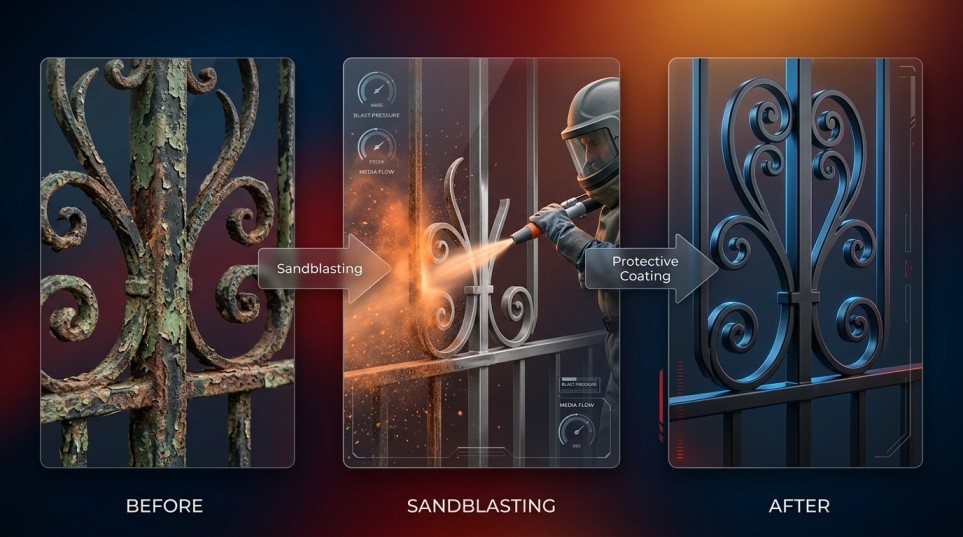
Bare sandblasted ironwork can start to rust again in as little as 30 minutes to 4 hours in damp or humid air, and usually within 24 to 48 hours even in a dry, covered workshop. That surprises most people. Sandblasting does not protect metal. It strips the metal back to a clean, chemically active surface and starts a clock. What decides how long your gates, railings, or wrought ironwork stay rust-free is the coating system applied after blasting, how quickly it goes on, and where the ironwork lives once it is back in place. Get those three right and a fully coated gate can realistically hold for 8 to 20 years before it needs anything more than a wash and a touch-up.
This guide explains the real timescales, why flash rust appears so quickly, how soon blasted ironwork needs painting, and what actually drives the lifespan of a finish in the UK climate.
Key takeaways
- Blasting cleans; it does not protect. Freshly blasted iron has zero corrosion resistance until a coating goes on.
- The blast-to-paint window is short. Same-day coating is the safest approach. Damp air, cold metal, and coastal or roadside contamination shorten that window further.
- The coating system decides the lifespan, not the blasting alone. A zinc-rich primer with a two-pack topcoat behaves very differently from a single hand-applied metal paint.
- Exposure changes everything. Two identical gates, one sheltered under a porch and one on an open driveway beside a gritted road, can differ by many years in service life.
- Preparation standard and surface profile matter. A surface cleaned and profiled to a recognised standard such as Sa 2½ gives a coating a far better chance of holding.
How Long Sandblasted Ironwork Lasts Before Rust Returns
The honest answer depends on whether the ironwork is bare, primed, or fully finished. Here is the realistic picture for typical UK gates, railings and decorative ironwork.
| Condition of the ironwork | Time before rust reappears |
| Bare blasted metal, damp or humid air | 30 minutes to 4 hours |
| Bare blasted metal, dry covered workshop | 24 to 48 hours |
| Primer only, no topcoat | 6 to 12 months |
| Fully painted or powder coated, sheltered | 15 to 20 years |
| Fully painted or powder coated, fully exposed | 8 to 15 years |
These are typical ranges seen in general trade practice, not guarantees. Actual results vary with the coating specification, the application quality, the condition of the original metal,l and the environment the ironwork sits in.
Why Bare Blasted Metal Rusts Within Hours
Rust needs three things: iron, oxygen,n and moisture. Blasting removes everything that was standing between the iron and the other two.
Before blasting, old paint, mill scale, grease, and even a stable layer of existing rust act as a partial barrier. After blasting, none of that is left. You are looking at raw, freshly exposed iron. Two things then work against you at once.
First, the surface is chemically active. Newly exposed metal reacts readily with oxygen and water vapour, so oxidation begins almost immediately once a thin film of moisture forms.
Second, blasting deliberately roughens the metal to create a surface profile, and that roughness dramatically increases the surface area exposed to the air. More surface area means more places for moisture to sit and more reaction sites.
In practical terms, on a humid British morning you can watch a blasted gate change colour. A light orange bloom can appear across the panels before the operator has finished cleaning down the workshop.
Why Properly Coated Gates and Railings Last for Years
A coating works by keeping water and oxygen away from the iron, and in some systems by adding a second line of defence.
Barrier protection is the simple part. Paint, powder coating or a multi-coat system forms a physical film that water has to get through before it can reach the steel. The thicker, more continuous, and better bonded that film is, the longer it holds.
Sacrificial protection is what makeszinc-basedd systems perform so well. Zinc-rich primers and hot-dip galvanising put a layer of zinc in contact with the steel. Zinc corrodes in preference to iron, so where the coating is scratched or chipped, the surrounding zinc gives up first, and the exposed steel is protected for a period rather than immediately rusting.
That combination is why a well-specified, well-applied system on properly prepared ironwork can run for fifteen years or more, while the same gate painted straight over rust with a brush might show breakthrough in a single winter.
Flash Rust: Why Freshly Blasted Iron Rusts So Fast
Flash rust is the light orange or brown discolouration that forms on freshly blasted steel and iron, often within hours. It is not the same as the deep, flaking corrosion you started with, but it still matters. Painting over flash rust puts a coating on top of a loose, unstable layer, and that is a common cause of early coating failure.
What Light and Heavy Flash Rust Look Like
Light flash rust shows as a faint, even golden or pale orange tint across the blasted surface. Wiped with a clean, dry cloth, it leaves only a slight mark. In some industrial specifications,s a very light degree of flash rust is tolerated with certain primers, but that is a decision for the coating specification, not a general rule.
Moderate to heavy flash rust looks darker and patchier. It shows as brown streaks running from corners, welds, scrollwork and joints, and it comes away readily on a cloth or a gloved hand as a loose powder. At that stage the surface is no longer the clean, sound substrate the coating manufacturer assumed. In most cases the practical answer is to re-blast rather than to paint over it.
Pitted or heavily corroded old ironwork tends to flash rust faster and more unevenly, because moisture and contamination sit inside the pits and are harder to remove.
Humidity, Metal Temperature and the Dew Point
This is the part that catches people out, and it is worth understanding before booking work in.
The dew point is the temperature at which moisture in the air condenses onto a surface. If the metal is at or near the dew point, an invisible film of water forms on it. That film is all rust needs.
Common practice in the protective coatings trade is to keep the steel temperature at least 3°C above the dew point during blasting and coating, and to keep relative humidity within the limits set by the coating manufacturer, often below 85%. On a cold morning, metal that has been stored outdoors or in an unheated space is frequently colder than the surrounding air, which makes condensation more likely even when the day feels dry.
That is why the same gate blasted in a heated workshop in July and blasted outdoors in November behaves so differently. In one case, you may have a comfortable working day. In the other, the usable window between blasting and coating can shrink to a couple of hours.
Salt, Road Spray and Airborne Contamination
Salt makes water far more aggressive. It increases the conductivity of the moisture film and speeds up the electrochemical reaction that produces rust.
Ironwork that has spent years beside a busy road picks up chlorides from winter grit and road spray. Coastal ironwork picks up airborne salt. Farm gates and railings near livestock or fertiliser storage can pick up other contaminants. Even after blasting, salts that were driven deep into pits and crevices can draw moisture back to the surface, which is why some previously road-exposed gates flash rust noticeably faster than clean, sheltered ironwork blasted on the same day.
Blast Dust and Soluble Salts Left on the Surface
Two forms of contamination need dealing with after blasting, and they are different problems.
Blast dust is the fine residue of spent abrasive and removed coating left sitting on the surface. It is loose, and if a coating goes on top of it, the coating is effectively bonded to dust rather than to metal. Dust is normally removed by careful blowing down with clean,n dry air, vacuuming, or both. In industrial work,rk the amount of residual dust can be assessed with a simple tape test method described in ISO 8502-3.
Soluble salts are invisible and cannot be blown off. Chlorides and sulphates left in the surface pull moisture through a coating film by osmosis and are a well recognised cause of blistering and early breakdown. Where a specification requires it, salt levels are measured using a sampling method such as the Bresle test in ISO 8502-6 and 8502-9, and heavily contaminated surfaces may need washing before or during preparation. Whether that step is needed on a domestic gate depends entirely on where the gate has been and what coating system is going on it.
How Soon Blasted Gates and Railings Need to Be Painted
The practical rule for most ironwork is straightforward. Get a primer on the same day, ideally within a few hours of blasting. Every hour after that, in typical UK conditions, works against the finish.
Why Same-Day Coating Is the Safest Option
Same-day coating means the primer bonds to a clean, dry, freshly profiled surface, which is exactly what the coating manufacturer’s data sheet assumes. Nothing has had time to bloom, nothing has been rained on, and the surface profile is still clean and sharp.
It also removes a second risk: handling. Blasted ironwork picks up fingerprints, and the oils and salts from bare hands are enough to leave marks that later show through a coating. The shorter the bare metal stage, the fewer chances there are for contamination.
If you are having gates or railings blasted and painted by separate parties, the sequencing matters more than the individual prices. A cheap blast followed by a three-day wait for a painter can easily cost more in the long run than a coordinated job.
Whether Blasted Ironwork Can Safely Be Left Overnight
Sometimes, but only under controlled conditions.
Blasted ironwork left in a dry, enclosed, heated, or at least temperature-stable space, off the floor, protected from draughts carrying moisture, will often still be sound the following morning. Ironwork left outside, in an open-sided store, on a concrete floor overnight, or under a sheet that traps condensation, frequently is not.
The honest position is that overnight storage is a compromise. It can work, and it is done regularly in workshop settings, but it introduces risk that same-day coating avoids. If the ironwork will be left, it is worth agreeing in advance who inspects it before coating and what happens if flash rust has appeared.
How to Store and Protect Ironwork Before It Reaches the Painter
If there has to be a gap between blasting and coating, a few practical measures help.
- Keep it indoors and dry. A closed workshop or garage is far better than a covered yard.
- Keep it off the ground. Stands, trestles or timber bearers allow air to circulate and stop moisture wicking up from a cold concrete slab.
- Avoid wrapping in plastic sheeting. Sealed plastic traps moisture against the metal and can make condensation worse rather than better. Breathable covers, where used at all, are the safer choice.
- Handle with clean gloves. Bare hands leave salts and oils on the surface.
- Do not let it get rained on. Rain on bare blasted iron is the fastest way to lose a good blast.
- Consider a holding primer. Where a delay is unavoidable, some coating systems allow a compatible holding or shop primer to be applied quickly, with the full system built up later. Compatibility has to be checked against the intended topcoat, so this is a decision to take with whoever is applying the final finish.
What to Do If Flash Rust Has Already Appeared
Do not simply paint over it and hope. The reliable route is to remove it and get back to a sound surface.
For light flash rust, a sweep blast, which is a quick, lower-intensity pass over the already blasted surface, usually restores the surface without significantly altering the profile. For heavier flash rust, especially on pitted wrought iron where the corrosion has gone back into the pits, full re-blasting is normally the sensible answer.
Two cautions are worth stating plainly. First, rubbing back flash rust by hand with random abrasives can polish the surface and destroy the profile the blasting created, which then reduces coating adhesion. Second, if the original coating on old ironwork may contain lead-based paint, which is a genuine possibility on Victorian and Edwardian railings and older gates, removal is a controlled operation with real health risks. It is not a job to attempt at home with a sander or a wire wheel.
How the Blast Standard Affects How Long the Coating Holds
Not all blasting produces the same result. Two contractors can both say a gate has been sandblasted and deliver very different surfaces. Standards exist precisely so that the level of cleanliness can be described and agreed rather than guessed at.
What Sa 2½ Means for Gates, Railings and Wrought Iron
Sa 2½ comes from ISO 8501-1 and is described as very thorough Sa 2½ blast cleaning.. In plain terms, the surface should be free of visible oil, grease, dirt, mill scale, rust, and old coatings. Only slight traces are permitted, and those should show as no more than light shading, spots,s or stripes across the surface. It sits between Sa 2 (thorough blast cleaning, where more staining is acceptable) and Sa 3 (blast cleaning to visually clean steel, where no traces remain at all).
Sa 2½ is the level most protective coating systems for exterior steelwork are specified against, which is why it comes up so often in quotes and data sheets. For decorative and architectural ironwork, it is a practical target because it produces a clean, uniform surface that primers are designed to bond to.
One realistic caveat applies to genuine old wrought iron and heavily pitted metalwork. Deep pitting can retain staining and contamination at the bottom of the pits even after thorough blasting, and a hundred-year-old gate will not come up looking like new fabricated steel. A good contractor will tell you what is achievable on your specific ironwork after seeing it, rather than promising a uniform result in advance.
Why Surface Profile Decides Coating Adhesion
Cleanliness is only half the job. The other half is profile, sometimes called the anchor pattern or surface roughness.
Blasting with angular abrasive leaves a microscopic peak and valley texture across the metal. Coatings grip that texture mechanically, in much the same way that a key grips a lock. Without it, a coating is relying on chemical adhesion to a smooth surface, and it is far easier to knock off.
Profile can be wrong in both directions. Too shallow and there is not enough for the coating to key into, so adhesion suffers. Too deep or too sharp,p and the peaks can stand proud of the applied film thickness, which leaves pinpoints of steel effectively uncovered and produces small rust spots later.
The right profile depends on the coating system being used, which is why the abrasive media and the blasting approach should be chosen with the finish in mind. Media selection is not one size fits all. The abrasive suited to heavy structural steel is not necessarily right for thin decorative scrollwork or lightweight sheet panels, where the risk of distortion has to be managed. That judgement is part of the job, and it is one of the reasons the blasting and the coating are best treated as a single specification rather than two separate purchases.
How Long Each Finish Lasts on Blasted Ironwork
Once the ironwork is clean and profiled, the finish you choose largely decides the service life. These are typical UK outdoor ranges under normal maintenance, not guarantees.
| Finish applied after blasting | Typical life outdoors in the UK | Best suited to |
| Hand-applied metal paint | 3 to 7 years | Small garden gates, quick refresh, decorative ironwork |
| Spray primer with topcoat | 8 to 12 years | Railings, fencing, general domestic metalwork |
| Zinc-rich primer with two-pack topcoat | 15 to 20 years | Security gates, commercial and industrial gates |
| Powder coating | 10 to 15 years | Driveway gates, modern steel gates, garden furniture |
| Hot-dip galvanising with paint over | 20 to 30 years | Heavy steel gates, structural and industrial metalwork |
A few notes worth understanding before you choose.
Hand-applied paint is the most accessible option, and it suits ornate ironwork where brushwork gets into detail that spray struggles to reach evenly. Film thickness tends to be lower and less uniform, so the trade-off is a shorter cycle between repaints.
Spray primer with topcoat gives a more even film and a better finish on flat panels and repeated bar work. It is the common middle ground for domestic railings and fencing.
Zinc-rich primer with a two-pack topcoat is the step up in real corrosion protection, because it adds sacrificial zinc under a hard-wearing topcoat, typically a two-pack polyurethane. It is the system of choice where the ironwork is exposed, security-critical, or expensive to take down and redo.
Powder coating produces a tough, attractive, consistent finish and is popular on modern driveway gates. Its weak points are usually edges, welds,s and any damage that breaks the film, since a chip in a powder film on bare steel gives moisture a direct route in. Blasting before powder coating, and specifying a zinc-rich primer beneath it or galvanising first where budget allows, addresses much of that.
Hot-dip galvanising with paint over it, often called a duplex system, gives the longest life of the group. The paint protects the zinc, the zinc protects the steel, and the two together typically last longer than either would alone. It is a workshop process carried out at a galvanising plant, requires vent and drain holes in hollow sections, and carries some risk of distortion on thin or asymmetric fabrications. It is best considered at the design or full restoration stage rather than as a quick refresh.
Why the Full Coating System Decides Durability, Not the Blasting Alone
It is tempting to think of blasting as the expensive bit that buys you the years. It is not quite like that.
Blasting sets the ceiling on how well the coating can perform. A poor blast, or a good blast left too long before coating, caps the achievable life no matter how good the paint is. But excellent blasting followed by a thin, single-coat finish on an exposed driveway gate will still be back in front of you within a few years.
Durability comes from the whole system working together: the standard of cleanliness, the surface profile, the primer chemistry, the total dry film thickness, the number of coats, the conditions during application, the coverage on edges and corners, and the maintenance afterwards. Edges are worth a particular mention, because paint films naturally thin over sharp arrises and bolt heads, which is why rust so often starts at the corner of a picket or the edge of a bracket rather than in the middle of a panel.
Where the Ironwork Sits and How That Changes Its Lifespan
Environment is the variable people underestimate most. Two identical gates, coated on the same day with the same system, can differ by five years or more depending on where they end up.
Indoor and Covered Ironwork
Interior railings, balustrades in covered stairwells and ironwork under a deep porch have an easy life. There is little wetting, little UV, and little contamination. Coatings on sheltered ironwork routinely reach the upper end of the ranges above, and failure, when it comes, is often cosmetic rather than corrosive.
The main risks indoors are localised: condensation in unheated spaces, splashing near entrances, and cleaning products used on adjacent floors that end up on the base of balusters.
Fully Exposed Gates, Railings and Fencing
Fully exposed ironwork takes rain, UV, wind-driven moisture, freeze-thaw cycling and temperature swings all year round. Expect the lower end of the ranges, and expect wear to concentrate in predictable places.
Look at the bottom rails and feet, where water sits and where mud or leaf litter holds moisture against the metal. Look at hinges, latches and moving joints, where the coating is repeatedly disturbed. Look at the tops of horizontal surfaces, which stay wet longest. On driveway gates, the leading edges take stone chips from tyres.
Simple habits extend the life noticeably: keep vegetation off the ironwork, clear soil and gravel from around the feet, and rinse the gates down occasionally rather than never.
Ironwork Near Busy Roads and Winter Grit
Gates and railings on a road frontage face the hardest conditions of any domestic ironwork in the UK, and the reason is winter grit.
Road salt is thrown up by passing traffic as a fine spray, settles on the ironwork and stays there. Chlorides then accelerate corrosion at any point where the coating is broken, and they keep working long after the visible dirt has washed off. Roadside railings and driveway gates in a village or town centre often need attention years earlier than an identical gate at the back of the same property.
The practical response is not complicated. Wash roadside ironwork down with clean water in early spring, once the gritting season ends, paying attention to the bottom third where spray lands hardest. Touch up chips as they appear rather than waiting for the annual look. Where ironwork sits in this position, specifying a zinc-based system at the outset is usually money well spent.
Signs Your Gates or Railings Are Due for Recoating
Catching a coating before it fails is much cheaper than dealing with the corrosion that follows. Watch for these.
- Chalking, where the surface leaves a fine powder on your hand, and the colour looks faded and dull.
- Loss of gloss across whole panels, particularly on the south-facing side.
- Rust staining running down from joints, welds, fixings or scrollwork, even where the metal itself still looks sound.
- Small blisters in the paint film, which usually mean moisture is getting underneath.
- Flaking or lifting at edges, bottom rails and hinge points.
- Spotting on the flats, where tiny rust points appear across an otherwise intact panel.
Isolated chips can often be touched up. Once you are seeing chalking plus rust breakthrough in several places, a full strip and recoat generally gives better value than repeated patching, because patch repairs on a failing film rarely last.
Sandblasting Ironwork in Reading and Berkshire
For property owners around Reading and across Berkshire, most of the ironwork that comes in for blasting falls into a few familiar groups: Victorian and Edwardian railings on period frontages, wrought iron and steel driveway gates, estate and field gates, balustrades and balconies, and decorative garden ironwork.
The decision is usually the same one. The paint has broken down, rust is showing, and the choice is between another coat over a compromised surface or taking it back to bare metal and starting again with a proper system. Blasting is what makes the second option viable, because it removes the failed coating and the corrosion together and leaves a surface a new coating can actually bond to.
If you are weighing that up, it is worth talking through the ironwork’s exposure, its age and condition, and the finish you want before anything is booked in. Blastec Sandblasting Services works with ironwork across Berkshire, including sandblasting for gates and sandblasting for railings, and can advise on what a specific piece is likely to look like once it is stripped back.
How the Local Climate Affects the Gap Between Blasting and Painting
Berkshire’s climate is temperate and, for these purposes, damp. That directly affects how quickly blasted ironwork has to be coated.
Relative humidity in the UK regularly sits high through the mornings and evenings for much of the year, and in the Thames Valley, low-lying and river-adjacent sites hold morning mist and heavier dew than higher, more open ground nearby. Autumn and winter are the difficult months, because metal that has been stored cold frequently sits close to the dew point, and condensation can form on a gate that looks and feels perfectly dry.
The practical consequences are worth planning around.
In summer, with warm metal and lower humidity, there is usually a comfortable working window between blasting and priming, though it is still measured in hours, not days.
In autumn and winter, that window narrows considerably. Same-day, and preferably immediate, coating becomes the working assumption rather than the ideal. Workshop blasting with controlled conditions has a clear advantage over outdoor work in these months, because temperature and humidity can be managed rather than simply endured.
For any job where the ironwork has to be transported between a blasting facility and a painter or powder coater, winter is when that logistics gap does the most damage. Agreeing the sequence up front, and keeping the bare metal stage as short as possible, is the single most useful thing you can do to protect the result.
Conclusion
Sandblasted ironwork does not stay clean for long. Bare blasted metal can flash rust in under an hour in damp air and rarely lasts beyond a day or two even indoors, which makes the gap between blasting and coating the most important window in the whole job. Once a proper system is on, the picture changes completely, and a well-prepared, well-coated gate or set of railings can give anywhere from eight to twenty years of service depending on the finish and the exposure.
The three things that decide the outcome are consistent: how thoroughly the metal is prepared, how quickly it is coated afterwards, and which coating system is specified for where the ironwork actually sits. Blasting alone protects nothing. Blasting done properly and followed straight away by the right finish protects for years.
If you have gates, railings or wrought ironwork that is showing rust and you want to know what condition the metal underneath is really in, get in touch with Blastec Sandblasting Services to discuss the piece and request a quote for blasting and preparation. A short conversation about the ironwork’s age, exposure, and intended finish will tell you far more than any online estimate can.