Most domestic items- a garden gate, a set of wheels, a cast iron radiator are blasted in a matter of hours, not days. The part that surprises people is that blasting turnaround Reading is rarely decided by the blasting itself. It is decided by workshop scheduling, by how long bare metal can safely sit before it is coated, and by what happens to the item next. A gate that takes ninety minutes in the blast room might still be a two-day job if it arrives on a busy Friday with hinges and locks still attached and no painter booked at the other end. Understanding where the time actually goes is the fastest way to get your own job moving.
Key takeaways
- Blasting time and turnaround time are two different numbers, and the gap between them is where most delays sit.
- Freshly blasted steel begins to flash rust quickly in the UK climate, so the coating stage effectively sets your deadline, not the blasting stage.
- Rust severity, coating thickness, hardware removal and item complexity change the time needed far more than overall size does.
- Same-day work is realistic for small, simple, single items when the workshop has capacity; multi-part restoration work cannot be compressed without affecting finish quality.
- Sending clear photographs, dimensions and a description of the existing coating with your first enquiry is the single most useful thing you can do to shorten the process.
Typical Sandblasting Turnaround Times in Reading
The table below gives realistic working guides for common items. Treat them as indicative planning figures rather than fixed quotes. Actual timings depend on the condition of the item when it arrives, the coating already on it, workshop workload on the day, and what finishing work is needed afterwards. Any item should be assessed before a firm timescale is confirmed.
| Item | Blasting time | Realistic turnaround |
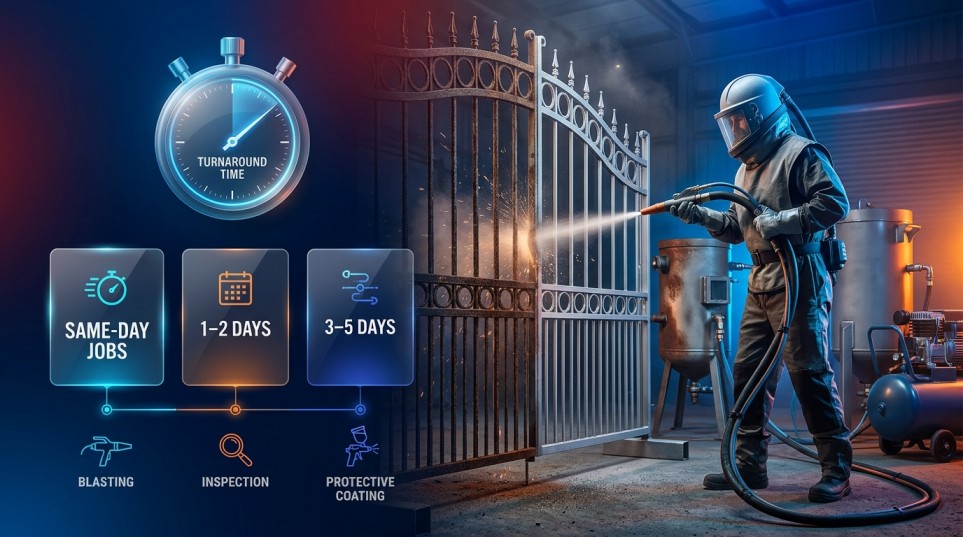
| Single garden or side gate | 1 – 2 hours | Same day |
| Pair of driveway gates | 2 – 4 hours | Same day to next day |
| Set of four wheels | 2 – 3 hours | Same day to next day |
| Cast iron radiator | 1 – 3 hours | Same day to next day |
| Garden furniture set | 3 – 5 hours | 1 – 2 days |
| Railings, per 5–10 metres | Half a day | 1 – 2 days |
| Car body panels, per panel | 1 – 2 hours | 1 – 3 days for a set |
| Full chassis or subframe | 1 – 2 days | 3 – 5 days |
| Motorcycle frame | 2 – 4 hours | 1 – 2 days |
| Wooden door | 2 – 4 hours | 1 – 2 days |
Why Blasting Time and Turnaround Are Not the Same Thing
Blasting time is the period the item spends in the cabinet or blast room with the nozzle working on it. Turnaround is everything from the moment you make contact to the moment you collect a finished item.
Between those two points sit several stages that rarely appear in anyone’s mental estimate: assessment, booking into the schedule, drop-off or collection, stripping hardware, masking anything that must not be blasted, the blasting itself, inspection, and then either immediate priming or handover for coating. On a straightforward gate, the blasting may genuinely be the shortest part of the day.
This matters when you are planning around a builder, a painter or a powder coater. Asking “how long does sandblasting take” will give you the first number. Asking “when can I collect it, ready for paint” will give you the number you can actually plan with.
The Clock That Really Decides Turnaround
Why Blasted Metal Cannot Sit and Wait
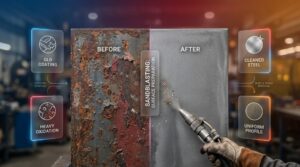
Blasting strips a steel or iron surface back to bare, clean, textured metal. That surface is chemically active and completely unprotected. In the humidity typical of Berkshire, a blasted ferrous surface can begin to develop a light surface bloom, flash rust, within hours rather than days, and faster still in damp or cold conditions where condensation forms on cool metal.
Flash rust is not the same as the pitted corrosion you brought the item in with, but it does compromise the clean profile the blasting created. If a coating goes on over it, adhesion and long-term performance may be affected. There is no fixed safe window that applies to every item: the time available depends on the metal, the storage conditions, the humidity on the day, and the coating system planned.
The practical consequence is simple. A blasting job is not finished when the nozzle stops. It is finished when the surface is protected. That is why scheduling is built around the coating step, not around the blasting step.
Why Same-Day Collection Matters More Than Fast Blasting
Customers sometimes push hard for the quickest possible blasting slot and then leave the item sitting for several days before collection. That is usually the wrong thing to optimise.
If your item is going straight out for painting, powder coating or galvanising, the useful question is which day you can collect it and move it on, not which morning it can go in the blast room. A gate blasted on Tuesday and collected on Tuesday afternoon is in better condition going into paint than one blasted on Monday and collected on Thursday.
Where an item cannot be collected promptly, a holding primer can sometimes be applied to protect the surface in the interim. Whether that is appropriate depends on the coating system you intend to use afterwards, because not every primer is compatible with every topcoat or powder process. It is worth raising at the quote stage rather than at collection.
Where Painting or Powder Coating Fits Into the Timeline
Blasting and finishing are separate operations with separate timescales. If both are being done, the overall turnaround is the sum of the two plus any transport between them.
Powder coating in particular runs to its own schedule, as items are batched, cured in an oven, and allowed to cool. A gate that is blasted in two hours may wait for the next coating run. If a third party is doing the coating, their availability becomes part of your timeline, and their capacity on a given week is outside the blaster’s control.
The fastest overall outcome almost always comes from booking both stages before the item leaves your property, so there is no dead time in the middle while bare metal sits waiting for a slot.
What Affects Blasting Turnaround Reading?
Size, Shape and Complexity of the Item
Surface area matters, but shape often matters more. A flat panel is quick because the nozzle can work at a consistent angle and distance. An ornate wrought iron gate with scrollwork, finials, twisted bars and tight internal corners takes longer per square metre because the operator has to work into every face of every component from multiple angles.
Two gates of identical width can therefore need very different amounts of time. A plain tubular field gate and a heavily detailed Victorian-style gate are not comparable jobs. The same applies to a smooth alloy wheel versus a multi-spoke design, or a plain radiator versus a decorative column radiator with deep sections.
Rust Severity and Coating Thickness
Light surface rust under a single coat of paint comes away quickly. Decades of accumulated paint layers, or heavy scaling and pitted corrosion, take considerably longer. Some older gates and railings carry six or more historic coats, each needing to be worked through.
Deep pitting adds time at the inspection stage too. Corrosion products can sit inside pits and need further work to clear, and once the surface is clean, pitting sometimes reveals thinning or holes that were hidden under paint. That is useful to know before you commit to coating, but it can change the plan mid-job.
One particular condition worth flagging early: older painted ironwork, especially pre-1980s gates, railings and radiators, may carry lead-based coatings. Removing such coatings requires additional handling and containment precautions, which affects both the process and the schedule. If your item is old and heavily painted, say so when you enquire.
Material Type and How Gently It Must Be Handled
Different substrates need different media and different techniques, and the gentler the approach required, the longer the work usually takes.
Structural steel tolerates a more aggressive approach than thin automotive panel, where excessive heat or pressure can distort the metal. Cast iron is strong in compression but brittle, and items like radiators and decorative castings need care around thin sections and joints. Aluminium wheels and castings are softer than steel and need media and settings chosen for that. Galvanised items raise a separate question entirely, because blasting can remove or damage the zinc layer that was protecting them.
Wood is a different discipline again, usually handled with gentler media and lower settings to lift coatings without tearing into the grain or raising the surface. A wooden door is not simply a smaller version of a steel one.
There is no single abrasive or pressure setting that suits every job, which is why media selection is part of the assessment rather than a default.
Masking, Disassembly and Hardware Removal
This is the most common source of avoidable delay in domestic work.
Hinges, locks, latches, bearings, bushes, glass, rubber seals, badges, threaded inserts and electrical components usually need to come off or be masked before blasting. If they arrive attached, that work has to happen in the workshop, and it is charged time that also pushes the item further down the day.
Items that come in already stripped, with fixings bagged and anything that must be protected clearly identified, can often go straight into the queue. On a pair of driveway gates, prior removal of ironmongery can be the difference between same-day and next-day collection.
Workshop Workload and Time of Year
Capacity is finite. A blast room can only process one job at a time, and a large commercial item occupying it for a day affects everything booked behind it.
Demand is also seasonal. Spring and early summer bring a surge in gates, railings, garden furniture and restoration projects, as people prepare outdoor metalwork for the warmer months. Late autumn and winter tend to be quieter for garden work but busier for vehicle restoration projects being prepared over the off-season. Booking a week or two ahead during busy periods gives far more control over your date than calling on the morning you need it done.
Fixed Items and Workshop Turnaround
If Your Item Has to Be Taken Down First
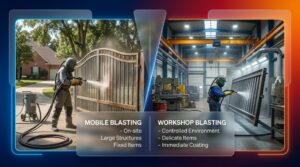
Fixed railings, balustrades and large gates hung on substantial posts need to be removed before they can come to our workshop, as we do not offer on-site blasting. Removal and refitting add time at each end of the job, so it is worth booking your fitter and your blasting slot together.
Once the item arrives, workshop blasting is quick and predictable. There is no setup or containment to arrange at your property, and the job is not delayed by the weather.
That is one of the main reasons we work indoors: a workshop slot is far less likely to be moved than an outdoor date in damp or cold weather.
When Workshop Blasting Is Faster
For anything that can be unbolted and transported, the workshop is usually quicker and more predictable. There is no containment setup for each job, no weather dependency, controlled lighting for inspection, and the ability to move straight into priming once the surface is clean.
Wheels, radiators, furniture, motorcycle frames, car panels, removable gates, and small fabrications all tend to turn around faster this way. The controlled environment also helps with the flash rust problem, since the item is not sitting outdoors between blasting and coating.
Collection, Delivery and Transport Time
Transport is real time and is easy to forget when estimating. Within Reading and the surrounding Berkshire towns, moving an item is usually a short trip, but it still has to fit around the working day at both ends.
Two things shorten it. First, having the item already detached and accessible when the vehicle arrives, not still hung on its hinges or bolted to a wall. Second, arranging drop-off and collection around the blasting slot rather than independently of it, so the item is not waiting at either end.
Larger or awkward items may need specific vehicle arrangements, which is worth establishing at the quote stage rather than on the day.
Same-Day and Next-Day Blasting: When It Is Realistic
Which Jobs Can Genuinely Be Finished the Same Day
Same-day work is realistic when several things line up: the item is small to medium, reasonably simple in shape, in moderate rather than severe condition, free of hardware, and the workshop has an open slot that day.
A single garden gate, one or two wheels, a radiator, a motorcycle frame or a handful of small brackets and fittings all fit that description. A pair of driveway gates can sometimes be done in a day, particularly if they are straightforward in design and have been stripped of ironmongery beforehand. If you are specifically looking at gates, the gate sandblasting service page sets out what that work typically involves.
Same-day availability always depends on capacity on the day. It is not a standing guarantee, and it is worth asking about when you first make contact rather than assuming.
Which Jobs Cannot Be Rushed Without Losing Quality?
Some work simply takes the time it takes.
A full chassis or subframe involves large surface areas, complex geometry, box sections, seams and areas that need careful attention from several angles. Multi-piece restorations, a complete set of body panels, a full garden furniture suite, long runs of railings involve repeated handling, inspection and finishing across many components.
Heavily corroded or thickly coated items are the other category. Pushing harder or faster on badly pitted metal risks damage rather than better results, and thin or distorted panels need a measured approach. Where an item needs a particularly gentle method because of its material or condition, time is the thing that is traded for a controlled finish.
If a timescale sounds too good for the item in question, that is worth questioning. Surface preparation quality directly affects how well the coating that follows performs and how long it lasts.
How to Get Your Job Turned Around Faster
What to Send When You First Make Contact
A good first message can remove an entire round of back-and-forth. Useful information includes:
- Clear photographs of the whole item plus close-ups of the worst-affected areas, taken in daylight.
- Dimensions: height, width, depth, and rough weight if you know it.
- Material, if you are sure: steel, wrought iron, cast iron, aluminium, galvanised steel, timber.
- Existing coating: paint, powder coat, galvanising, varnish, or unknown, and its rough age, which matters for older painted ironwork.
- What happens next: painting, powder coating, galvanising, or straight back into use.
- Your deadline, and whether it is fixed.
- Fixing details if the item is still in place and needs taking down first.
That set of details is usually enough to plan how the item gets to our workshop and roughly where it sits in the schedule.
What to Do Before the Item Arrives
Where it is safe and practical for you to do so, removing hinges, handles, locks, glass, rubber seals, bearings and any electrical fittings in advance saves workshop time. Bag and label the fixings so refitting is straightforward afterwards.
Give the item a basic clean to remove loose dirt, mud, grease and debris, and let it dry. Heavy grease and oil contamination generally needs degreasing before blasting, since blasting a contaminated surface can spread the contamination rather than remove it.
Do not attempt to strip coatings yourself with power tools or chemicals in the hope of speeding things up, particularly on older painted items where the coating may be hazardous. Partial DIY stripping often creates an uneven surface that needs more work, not less.
Having the Next Step Lined Up Before Blasting Starts
The single biggest improvement most people can make to their overall timeline is booking the coating stage before the blasting stage happens.
That means knowing who is painting or powder coating the item, what system they are using, when they can take it, and whether they want it primed on collection or delivered bare. Confirming coating compatibility in advance avoids the situation where a protective primer has been applied that the chosen topcoat or powder process cannot go over.
If you are coordinating it yourself, agree the handover day with both parties at the outset. If the blasting and coating are happening under one arrangement, ask for the combined timescale rather than the blasting timescale alone.
Sandblasting Turnaround Across Reading and Berkshire
Blastec Sandblasting Services works with customers across Reading and the wider Berkshire area. All blasting is done in our workshop at Cross Lane, Grazeley, for items that are dropped off or brought in.
Practically, that means turnaround for a Reading customer is governed by workshop scheduling rather than distance. For most domestic items the deciding factor remains the same: how complex the item is, what condition it is in, and how quickly it can move on to coating afterwards.
Local work does bring recurring patterns. Period properties across the area produce a steady flow of wrought iron gates, railings and cast iron radiators, often carrying many layers of historic paint. Driveway gates come in through spring and summer. Vehicle and motorcycle restoration work tends to cluster in the colder months. If your project falls into one of those seasonal peaks, booking ahead is the most reliable way to secure the date you want.
You can see the full range of work covered on the Blastec sandblasting services site.
Conclusion
The honest answer to how quickly something can be blasted in Reading is that the blasting is usually the quick part. A single gate, a radiator, or a set of wheels can often be done within a day. What turns that into a two-day or five-day job is complexity, corrosion, attached hardware, workshop workload, and, most of all, what has been arranged for the item once it comes out of the blast room with a clean, bare, unprotected surface.
If you want a firm timescale for your own item, the most useful step is to send photographs, dimensions, and a short description of its condition and what you plan to do with it afterwards. That allows the work to be assessed properly, a realistic date to be given, and the coating stage to be planned alongside it rather than after the fact.
Get in touch with Blastec Sandblasting Services to discuss your item and arrange a suitable blasting slot in Reading or elsewhere in Berkshire.