Metal sandblasting Reading comes down to choosing a company that understands what happens to your item after the blasting stops. Stripping paint and rust off steel is the straightforward part. Working out which abrasive suits the metal, protecting hinges and threads before the nozzle goes anywhere near them, and getting bare metal covered before it starts rusting again that is where the difference between a good job and an expensive disappointment sits.
Most people booking metal sandblasting in Reading are doing it once. You will not have a second item to compare the result against, and once primer goes on, the quality of the preparation underneath is hidden for good. So the judgement has to happen before you book, based on how a company answers a handful of practical questions.
Key points to hold onto:
- The only honest inspection point is bare metal, between blasting and coating. Ask to see the item at that stage.
- Media range matters more than years in business. A company set up only for heavy steel will struggle with alloy wheels or thin period ironwork.
- Bare steel can begin to flash rust within hours in UK weather. Find out who is covering that gap and how.
- A firm price given without seeing or discussing the item is a guess. Condition drives the work far more than size does.
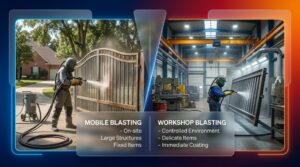
- Ask where the blasting is done. Workshop blasting gives more control over dust, weather and the finish than blasting on a driveway.
What Separates a Good Blasting Job From a Bad One
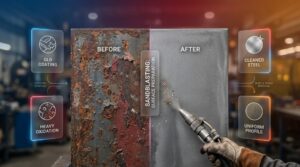
Blasting faults are easy to spot once you know what you are looking at, and almost impossible to spot afterwards. The table below covers what tends to show up on a well-handled job against what tends to show up when the work has been rushed, or the wrong setup has been used.
| Sign of good work | Sign of a poor job |
| Uniform grey finish with no dark patches left | Rust or old paint still visible in corners and joints |
| Even surface texture across the whole item | Polished patches where the nozzle sat too long |
| Hinges, threads and fixings clean and still moving | Grit packed into mechanisms, stiff movement |
| Thin panels still flat and true | Rippling or warping on sheet metal |
| Item primed or collected the same day | Left bare for days with flash rust forming |
| Condition problems pointed out before coating | Rust holes discovered only after painting |
None of these are cosmetic complaints. Paint or old coating left in a joint becomes the point where the new finish lifts first. Grit driven into a hinge barrel grinds away at it every time the gate swings. A warped panel never sits right again.
Why You Can Only Judge the Work Once It Is Bare Metal
There is a short window, after the blasting and before anything is applied, when the condition of your item is completely visible. Every pit, every thin section, every spot the abrasive did not reach is on show. Once primer goes on, all of it disappears under a uniform colour, and a poor strip looks identical to a thorough one.
That window is also when genuine problems surface. Rust frequently eats through from the inside of hollow sections, so a gate rail that looked solid under layers of paint can turn out to be perforated. A company working properly will stop at that point, show you, and talk through whether the section is worth repairing before any coating is applied.
It is reasonable to ask for photographs at bare metal, or to view the item yourself before it is coated. A firm confident in its preparation will not mind. One that would rather you saw the item only after painting is telling you something.
Questions Worth Asking Before You Book
You do not need technical knowledge to tell a careful operator from a careless one. You need five questions and a willingness to listen to how they are answered. Vague answers to any of these are worth taking seriously.
Which Abrasive Media They Would Use on Your Item
The term sandblasting is used loosely. In practice, the trade covers abrasive blasting, grit blasting, shot blasting, bead blasting,g and soda blasting, and the media behave very differently. Angular grit cuts aggressively and leaves a rough profile that coatings key into. Glass bead works more gently and leaves a smoother finish. Softer media are used where the substrate cannot take much energy.
What you want to hear is a media choice tied to your specific item and what you plan to do with it afterward, not a single answer applied to everything. Heavy wrought iron gates destined for powder coating and a set of alloy wheels are not the same job, and an operator who treats them as one has not thought about yours.
How They Protect Hinges, Threads and Moving Parts
This is the question that separates the trade quickest. Blasting media will find its way into any hinge barrel, lock mechanism, threaded fixing, bearing or electrical component that has not been masked beforehand. Once grit is packed into a mechanism, it is difficult to clear, and it accelerates wear from that point on.
Ask directly what gets masked and how. On automated gates, the motors, wiring, and control gear all need covering before anything starts. On vehicle components, threads, bearing surfaces and machined faces need the same treatment. A straight answer about masking is a good sign; a shrug is not.
How Soon the Item Needs Coating After Blasting
Freshly blasted steel is chemically clean and has no protection at all. In damp or humid conditions, a light orange bloom of flash rust can appear on bare steel within hours. If that happens before coating, the surface usually needs reworking.
So ask what the plan is for the gap. Options vary: some firms apply a holding primer straight after blasting, some time the work so the item goes directly to a painter or powder coater, and some arrange collection the same day. Any of these can work. What should concern you is a company with no answer at all, or one happy to leave bare metal sitting outdoors over a weekend.
Whether They Blast Only, or Also Repair and Finish
Some blasting firms strip the item and hand it back bare for you to arrange painting, powder coating or galvanising. Others coordinate the next stage. Neither approach is better, but you need to know which you are buying, because the difference shapes your timeline, your budget and who is responsible if the finish fails later.
If blasting reveals rust damage, ask who handles the welding or fabrication repair. If you are arranging the coating yourself, ask what surface standard the item will be handed over in and how long you have before it needs covering.
Where the Blasting Is Done
Some companies blast items where they stand using a mobile unit; others, like Blastec, work only in a workshop. Workshop blasting means the item is taken down and brought in, which gives better control over dust and weather and access to every face. It suits gates, railings, wheels, panels and components that can be removed.
If a company offers to blast on your driveway, ask how the area will be contained and what clean-up is included, particularly if you have neighbours close by, cars on the drive, or planting you would rather not see covered in grit.
Matching the Company to What You Need Blasted
Blasting companies tend to specialise, even when their websites suggest otherwise. The right question is not whether a firm does metal sandblasting, but whether it regularly handles items like yours.
Gates, Railings and Architectural Ironwork
Gates and railings are the most common domestic blasting job in Reading, and they bring their own set of problems. Decorative scrollwork, collars and joints hold rust and old paint in places no hand tool reaches, which is exactly why blasting suits them. But the same features make masking and nozzle control matter more.
With driveway gates, the practical question is how they come off their hinges and how long the gateway will be open. A company that regularly does gates and railings sandblasting will have a settled answer on hinge protection and how long the gates will be away.
Vehicle Panels, Wheels and Chassis Components
Automotive work is the area where the wrong setup does visible damage fastest. Body panels are thin, and too much energy concentrated in one spot builds heat and distortion that cannot be flattened out afterwards. Alloy wheels, chassis sections, subframes and motorbike frames each respond differently and generally call for different media and techniques.
If you are mid-restoration, say so when you enquire. The sequence matters: a bare chassis needs to go to primer or coating promptly, so the blasting wants to be timed around whoever is doing the next stage rather than booked in isolation.
Delicate, Ornate and Period Metalwork
Period ironwork, cast components, fine detail and thin sheet all need a restrained approach. Cast iron is more brittle than wrought iron. Original detail can be softened or lost if the surface is worked too hard, and on a period gate that detail is usually the reason it is worth restoring at all.
For anything original or hard to replace, ask what the operator would do differently compared with a standard steel gate. The answer should involve a gentler media choice and more controlled technique. If the reply is that it makes no difference, consider that your answer.
Timber and Mixed-Material Items
Blasting is not limited to metal. Wooden doors and garden furniture can be blasted to strip old paint and varnish, and the process can raise the grain in a way that suits some finishes. But wood is soft, and an approach suited to steel will tear into it.
Mixed-material items, a wooden gate with iron furniture, a bench with a metal frame and timber slats, need a company comfortable with both, because the two parts cannot be treated the same way. Older painted timber raises a separate point: paint on pre-1960s items may contain lead, which is hazardous to disturb and should only be handled by someone equipped to manage it safely. If your item is old and painted, mention it when you enquire rather than after work has started.
Experience and Equipment That Actually Matter
Most blasting websites lead with how long the company has been trading. It is a weak signal on its own. These three things tell you more.
Why Media Range Matters More Than Years in Business
A firm set up around one abrasive will use it on everything, because that is what is in the pot. That is fine if your item suits it and a problem if it does not. A company carrying a range of media has the option to match the abrasive to the metal, the condition and the finish you are heading towards.
When you enquire, the useful question is what they would use on your item and why. A specific answer, with a reason attached, tells you more about the operator’s judgement than a figure on a homepage.
Workshop Facilities and Containment
Ask what kind of workshop the company has and how dust and spent abrasive are contained. A proper indoor blasting area means a consistent finish, no weather delays and no grit left on your property.
Containment is the part worth probing. Abrasive blasting generates airborne particles and leaves spent media and removed coating behind, and that material has to be controlled and cleared, not simply left. Ask what screening is used, how far the dust is expected to travel, and who clears up afterwards. In a residential street with neighbouring properties close by, this matters as much as the blasting itself.
Evidence of Comparable Past Work
General experience is not the same as experience with your item. A company that has blasted structural steel for years may have done very few sets of ornate Victorian gates.
Ask to see work on something comparable: a similar gate design, the same type of wheel, a chassis from a similar era. Photographs taken at bare metal are more informative than finished shots, because the finished picture shows the painter’s work as much as the blaster’s.
Checking a Company Before You Commit
Once you have a shortlist, a few checks separate firms that look similar on paper.
Reviews, Photos and Before-and-After Work
Read reviews for detail rather than score. A review that describes the item, what was done, and how the company handled a complication is worth more than a dozen one-line ratings. Look especially for comments on communication when something unexpected turned up, since that is the situation where the difference between firms shows.
With before-and-after galleries, check whether the work matches what you need. A page full of chassis and wheels tells you little about how a company handles period gates. Where possible, look for intermediate photographs at bare metal rather than finished items only.
Service Coverage Across Reading and Berkshire
Check that your address genuinely falls within a company’s working area. Reading sits at the centre of a wide area taking in Newbury, Wokingham, Bracknell, Thatcham and the villages between, and coverage differs between firms.
Ask directly rather than relying on a list of towns on a website, and check the workshop opening hours for drop-off and collection.
Turnaround Time and What Happens to Your Item Meanwhile
Turnaround depends on size, condition, how much coating has to come off, access and the weather, so expect a range rather than a fixed figure. A small garden gate is a different proposition from a heavily corroded pair of driveway gates with decades of paint on them.
The more useful question is where your item sits in the meantime. If it goes to a workshop, ask whether it is stored under cover, when it will be blasted relative to collection, and when it needs to be coated. An item blasted on arrival and left bare for a week is in worse condition than one blasted the day before it goes for coating. For gates specifically, ask what happens to the gateway while they are away or being worked on; security and access are easy to overlook until the gates are gone.
Red Flags Worth Walking Away From
Three answers should make you pause and get another quote.
A Price Given Without Seeing the Item
Blasting cost is driven by condition far more than by size. Two gates of identical dimensions can differ substantially in work required if one carries a single coat of paint and the other has forty years of build-up over heavy rust. Access, media choice, masking requirements, containment and cleanup all feed into it too.
A rough indication over the phone is normal and reasonable. A firm quoted price for an item nobody has seen or asked questions about is not a quote; it is a number that will be revised once work starts, usually upwards. Expect clear photographs, or at minimum a detailed conversation about condition before a figure is confirmed.
No Plan for Protecting Hardware or Masking
If a company cannot explain what will be masked on your item before blasting starts, assume nothing will be. The consequences are not dramatic enough to spot immediately but show up later: a hinge that grinds, a lock that no longer turns smoothly, grit in a bearing, media inside a gate motor housing.
This matters most on automated gates, items with electrical components, and anything with threaded fixings or machined surfaces you need to keep usable. A competent operator will raise masking before you do.
No Answer on What Happens Between Blasting and Coating
A company that treats blasting as a job that ends when the nozzle stops has missed the point of the work. Preparation exists to give a coating something sound to bond to, and that benefit degrades from the moment the surface is exposed.
If the answer to what happens next is effectively “that is your problem”, weigh up whether you have the next stage lined up and the means to move a bare item quickly. Sometimes you will, and the arrangement is fine. But a firm that has not considered the question at all is unlikely to have given much thought to the preparation standard either.
Getting Your Metal Sandblasting Reading
Blastec Sandblasting Services is a local, fully insured blasting company based at Cross Lane, Grazeley, working across Reading and the wider Berkshire area, including Newbury and Wokingham.
The work covers both the domestic and automotive sides of metal sandblasting in Reading:
- Driveway gates, garden and side gates, security and industrial gates, and railings
- Wrought iron and cast iron gates, including decorative and period ironwork
- Automated and electric gates, with motors, wiring and mechanisms masked and protected before blasting
- Car panels, car parts, wheels, subframes, chassis and roll bars
- Motorbike frames and radiators
- Wooden doors and garden furniture
At Blastec, all blasting is done in our own workshop at Cross Lane, Grazeley. Items are taken down and brought in, and the right abrasive for the metal and what you plan to do with the item afterwards are discussed at the quote stage.
Items are prepared back to clean bare metal, ready for your choice of finish, hand-applied metal paint, spray primer, powder coating or galvanising. On commercial and industrial gates, preparation can be carried out to the surface cleanliness standards specified by industrial coating manufacturers.
Quotes are free and given after the item has been seen or properly discussed, not before. If blasting reveals rust damage underneath, perforation in a hollow section, for instance, you will be told at bare metal, while you still have options.
To talk through a project, or request a quote, get in touch with Blastec Sandblasting Services in Reading on 07432652243 or at blastec.reading@gmail.com. The workshop is open Monday to Friday, 8:00 am to 4:00 pm.
Conclusion
The companies worth booking are the ones that ask questions back. What is the item, what condition is it in, what finish is going on afterwards, and when? Those questions are not a stalling tactic before a quote. They are how an operator decides which abrasive to use, what needs masking, and how to time the job so your item is not sitting bare while rust gets a head start.
So judge on the answers, not the adjectives. Ask what media they would use and why, what gets protected before blasting starts, and what happens in the gap between stripping and coating. Ask to see the item at bare metal. A firm that handles work like yours regularly will answer all of that without hesitation, and the ones that cannot will usually show it in the first conversation.
If you have a gate, a vehicle component, or a piece of ironwork you are deciding about, contact Blastec Sandblasting Services to discuss the item and arrange a free quote.