The Best Way to Remove Rust from Car Parts in Reading, UK — A Complete Guide
Rust doesn’t sleep. One small patch of surface oxidation left untreated can spread through your car’s bodywork, suspension components, exhaust system, and chassis within months — especially in Reading’s wet Berkshire climate, where road salt and heavy rainfall work against every exposed metal surface on your vehicle.
If you’re searching for the best way to remove rust from car parts, you’re already ahead of most car owners who ignore the problem until the repair bill becomes eye-watering. The difference between a £150 treatment and a £1,500 panel replacement is often just a few months.
At Blastec Shotblasting Services, we’ve helped hundreds of customers across Reading and Berkshire restore rust-damaged metal to bare, clean, coating-ready surfaces using professional-grade sandblasting and surface preparation. In this guide, we share exactly what works — from DIY approaches for light surface rust, to the professional methods we use every day for deep corrosion and full restoration jobs.
What Is Car Rust Removal? (And What It Isn’t)
Car rust removal is the process of eliminating corrosion from ferrous (iron-containing) metal components — chassis rails, body panels, wheel arches, suspension arms, exhaust systems, and structural steel. Done properly, rust removal takes the affected surface all the way back to clean, bare metal before protective coatings are applied.
What it isn’t is painting over rust, applying a brush-on converter and leaving it, or sanding back just enough to make it look acceptable for a season. These approaches buy time at best and accelerate hidden corrosion at worst.
The most common rust removal methods used in professional and DIY settings are:
- Manual sanding and wire brushing — suitable for very light surface rust only
- Chemical rust converters — phosphoric or tannic acid products that neutralise rust chemically
- Electrolytic rust removal — a low-current process for delicate or intricate parts
- Professional sandblasting — high-pressure abrasive media that removes rust completely to bare metal
Each method suits a different stage of corrosion. Choosing the wrong one — or skipping straight to painting — is where most people go wrong.
Why Reading’s Climate Accelerates Car Rust
The Problem
Reading averages over 630mm of rainfall per year — well above the UK national average. Coupled with the road salt applied across Berkshire during winter months, this creates near-perfect conditions for electrochemical corrosion on any exposed or poorly protected steel. Cars driven daily on Reading’s A roads, ring roads, and motorway access routes are constantly exposed to salt spray thrown up from the road surface.
For older UK-registered vehicles — particularly those made before 2005, which had thinner factory corrosion protection — rust can take hold in as little as six to twelve months once the protective coating is compromised.
Why Ignoring It Is Expensive
Surface rust becomes scale rust. Scale rust becomes penetrating rust. Once corrosion has eaten through the metal, you’re no longer looking at a treatment job — you’re looking at panel cutting, welding, and replacement. What costs £100–£200 to treat today can easily become a £600–£1,500 repair job in 12 months.
There’s also the MOT to consider. In the UK, corrosion affecting load-bearing or safety-critical components — sills, chassis legs, suspension mounts, subframe mounting points, brake lines — is a statutory MOT failure. A vehicle with structural rust cannot legally be on the road until repaired. Many Reading drivers receive MOT advisories for rust and do nothing, only to face a failure the following year.
The Solution
The best way to remove rust from car parts depends entirely on how far the corrosion has progressed. Caught early, surface rust can be dealt with relatively simply. For anything beyond that — bubbling paint, pitting metal, or structural areas — professional treatment from a specialist like Blastec Shotblasting Services in Reading delivers results that DIY methods simply cannot match.
Best Methods to Remove Rust from Car Parts — A Practical Breakdown
1. Manual Sanding and Wire Brushing
Best for: Very light surface rust on accessible flat panels.
Using 80-grit sandpaper or a wire brush attachment on a drill, you can remove surface discolouration and light oxidation from small, easy-to-reach areas. This works well for catching rust early on door edges, bonnet lips, or boot lids before it spreads.
Limitations: Manual sanding cannot reach inside box sections, seams, or complex shapes. It also leaves fine scratches that trap moisture if not properly sealed. For anything beyond surface rust, this method is not sufficient.
2. Chemical Rust Converters
Best for: Moderate surface rust in areas too complex for sanding, such as bolt heads, brackets, or inner surfaces.
Products like Jenolite, Kurust, or Hammerite Rust Remover Gel use phosphoric acid to chemically react with iron oxide and convert it into iron phosphate — a stable, dark-coloured compound that can be primed over. These products are useful for areas you cannot easily sand and for treating surface contamination before applying primer.
Limitations: Chemical converters work on the rust they can contact — they do not penetrate deeply. On scale rust or pitted metal, the underlying corrosion beneath the surface layer is not fully treated. They also leave a chalky residue that must be fully removed before painting for good adhesion.
3. Electrolytic Rust Removal
Best for: Small, delicate, or intricate car parts such as carburettors, brackets, bolts, and vintage hardware.
Electrolytic rust removal uses a low electrical current passed through a water-and-washing-soda solution to reverse the oxidation process. The part is submerged and rust is drawn away from the metal surface. It produces excellent results on components that would be damaged by abrasive methods and leaves the base metal intact.
Limitations: Only practical for small, removable components. Not suitable for panels, chassis sections, or anything too large to submerge. The process is also slow — typically 12 to 48 hours per batch.
4. Professional Sandblasting — The Most Effective Method
Best for: All stages of rust, all component types, and any job where a complete, long-lasting result is required.
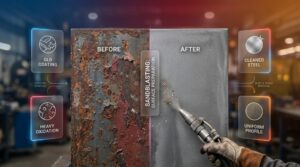
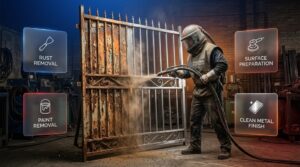
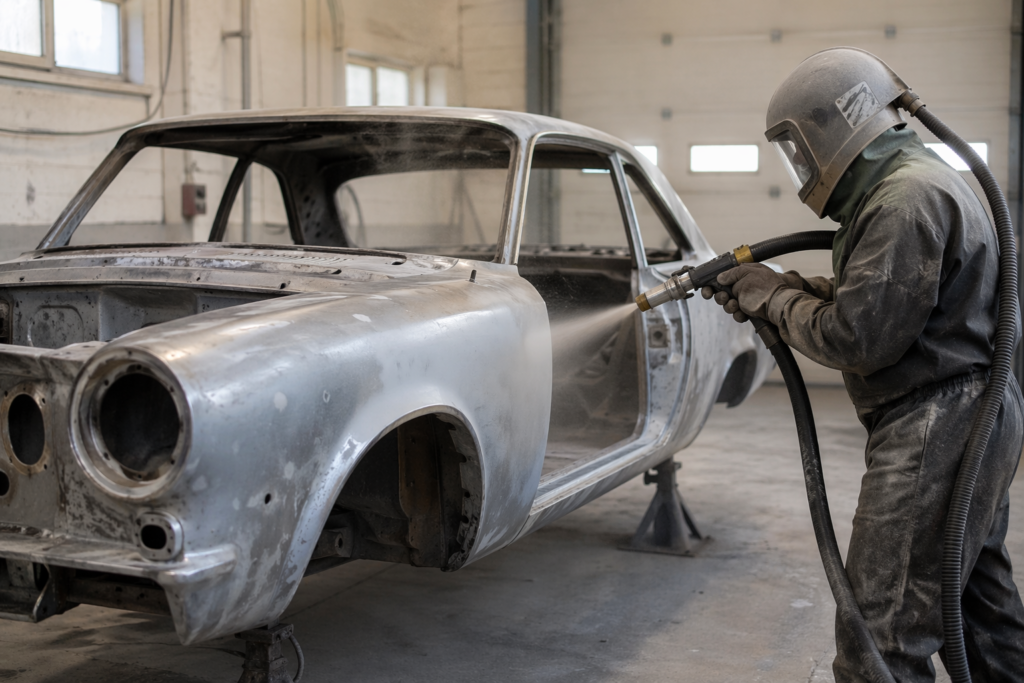
Professional sandblasting uses high-pressure compressed air to propel abrasive media (sand, grit, soda, or glass bead depending on the application) at the surface. This removes rust, old paint, mill scale, and contamination simultaneously — leaving behind a clean, profiled bare metal surface that coatings bond to far more effectively than any other preparation method.
- Removes rust completely from the surface — no residue, no hidden pockets
- Reaches inside seams, box sections, and complex profiles that sanding cannot access
- Creates a surface profile that dramatically improves paint and coating adhesion
- Suitable for chassis, panels, wheels, suspension components, roll cages, trailers, and more
- Delivers results that last — not a temporary fix
This is the same surface preparation method used in automotive restoration, aircraft maintenance, industrial metal fabrication, and structural steel treatment. It is the professional standard for a reason: nothing else achieves the same depth of removal or quality of surface preparation.
Why Professional Sandblasting Is the Best Solution for Car Rust in Reading
DIY rust treatment has its place — for very light surface rust caught early, a wire brush and a tin of converter will do the job. But for anything deeper, older, or structurally significant, DIY approaches consistently underperform. Here’s why professional sandblasting from Blastec Shotblasting Services delivers a fundamentally different result:
Complete Removal, Not Surface Treatment
DIY methods treat what they can see and reach. Sandblasting removes rust from every contour, corner, seam, and cavity — leaving nothing behind for corrosion to restart from. When we blast a chassis rail or a wheel arch, we’re taking it back to bare, clean metal across the entire surface, not just the parts you can get a brush into.
Superior Adhesion for Coatings
A blasted surface has a physical profile — microscopic peaks and valleys created by the abrasive media — that paint, epoxy primer, and protective coatings mechanically bond to. This is why professionally blasted and coated components last years longer than those prepared by hand sanding or chemical treatment alone.
Right Media for the Right Job
Not all blasting is the same. At Blastec, we select the correct abrasive media based on the component, the metal thickness, and the desired finish. Heavy chassis work uses coarse grit. Thin panels or aluminium components use softer media such as glass bead or soda to avoid warping or damage. This expertise is the difference between restoration and damage.
Inspection Opportunity
Once a component is blasted to bare metal, hidden rust, metal fatigue, cracks, and weak spots become visible for the first time. This is invaluable for restoration work and structural assessment — you often discover issues that couldn’t be seen through paint and underseal. Finding a thin chassis section before it fails is far preferable to finding it after.
Our Rust Removal and Blasting Services in Reading, Berkshire
At Blastec Shotblasting Services, we offer a full range of professional car rust removal and sandblasting services tailored to individual components, full vehicles, and commercial or industrial metalwork across Reading and Berkshire.
Car Parts and Automotive Rust Removal
Individual car parts — suspension arms, hubs, brackets, roll cages, wheels, subframes — blasted to bare metal and ready for coating. Ideal for restoration projects, track cars, and daily drivers needing component-level rust treatment.
Chassis and Structural Steel Blasting
Full chassis blasting for cars, vans, trailers, and agricultural equipment. We remove all surface rust, old underseal, and contamination to leave a bare, clean surface that can be inspected, repaired if needed, and then protected with wax, epoxy, or powder coat.
Classic and Restoration Vehicle Preparation
We work with restoration specialists, private collectors, and classic car owners across Reading and Berkshire. Whether it’s a 1960s Land Rover, a classic Mini, or a vintage American muscle car, we have the media selection and experience to prepare bodywork and chassis without causing damage to original metal.
Wheel and Brake Component Blasting
Alloy and steel wheels, brake drums, callipers, and discs blasted clean. Ideal for refurbishment before powder coating or painting, or for removing brake dust, rust, and old paint from wheels during restoration.
Industrial Metal Cleaning
Beyond automotive work, we provide blasting and surface preparation for industrial components, farm equipment, gates, railings, and structural steelwork across Berkshire and the surrounding counties.
Mobile Sandblasting Services
Can’t transport the item to us? Our mobile blasting service brings the equipment to you. We cover Reading and surrounding areas for on-site rust removal on larger structures, vehicles that can’t be moved, and farm or commercial equipment.
See our full services at: blastecreading.co.uk/sandblasting-car-parts
Real Work — Rust Removal Jobs We’ve Completed in Reading
Here are examples of the kind of work we carry out regularly for customers across Reading and Berkshire. (Add your own before/after photos below each example for maximum impact.)
Classic Land Rover Defender — Full Chassis Blast, Caversham
A Caversham customer brought us a Series-era Defender with heavily rusted chassis rails and outriggers. The chassis had been undersealed at some point — which had actually trapped moisture and accelerated corrosion beneath the surface. We stripped all old underseal and rust using coarse grit blasting, exposing the bare metal beneath. The customer could then inspect the metal properly, carry out any welding repairs, and apply a fresh epoxy primer and wax injection protection. This is one of the most common and most satisfying jobs we do.
Ford Cortina Restoration — Full Bodyshell Preparation, Woodley
A private restoration customer in Woodley dropped off a stripped Cortina bodyshell for full blast preparation before paint. We removed decades of paint, filler, and surface rust from the entire body, leaving bare metal ready for the bodywork restoration and respray. The customer was able to see, for the first time, exactly where previous repairs had been made and where genuine rust repairs were needed before a penny was spent on paint.
BMW Alloy Wheels — Refurbishment Prep, Reading RG2
A set of four corroded BMW alloy wheels, complete with kerb damage, flaking lacquer, and surface corrosion, were blasted clean using glass bead media — gentle enough not to damage the alloy, effective enough to remove all contamination and old coating. Handed back to the customer ready for powder coating. Total turnaround: two working days.
Why Choose Blastec Shotblasting Services in Reading?
- ✅ Local Reading-based team — we know the vehicles, the conditions, and the customers in Berkshire
- ✅ Fully insured and experienced — professional-grade work backed by proper insurance and years of hands-on practice
- ✅ Right media for every job — we select the correct abrasive for each component, protecting thin panels and aluminium while aggressively removing rust from heavy steel
- ✅ Fast turnaround times — most jobs completed within one to three working days, depending on scope
- ✅ Professional-grade equipment — not hobby compressors and bags of sand; proper commercial blasting rigs with the capacity to handle full chassis and bodyshell work
- ✅ Honest, transparent pricing — you’ll know exactly what the job costs before we start, with no hidden add-ons
- ✅ Free, no-obligation quotes — just call or send us photos of your parts and we’ll give you a clear, fair price
Who We Work With
Our car rust removal and sandblasting service in Reading is used by a wide range of customers across Berkshire and the south of England:
- Classic and vintage car restorers — private owners and specialist restoration workshops needing clean, bare-metal bodyshell and chassis preparation
- Daily driver owners — Reading residents needing MOT-related rust treated on chassis, sills, or structural components before their annual test
- Performance and track car builders — roll cages, subframes, wishbones, and suspension components stripped and prepared for coating
- Trade garages and body shops — professional workshops across Berkshire using us for component blasting on restoration and repair jobs
- Fleet and commercial operators — van fleets, HGV components, and commercial vehicle chassis treatment across Reading and Berkshire
- Agricultural and industrial clients — farm equipment, trailers, gates, and steelwork requiring surface cleaning and rust removal
Areas We Cover for Car Rust Removal and Sandblasting
Based in Reading, Berkshire, Blastec Shotblasting Services provides professional rust removal and sandblasting across a wide area, including:
Reading (all RG postcodes) | Caversham | Woodley | Earley | Tilehurst | Wokingham | Bracknell | Newbury | Basingstoke | Maidenhead | Windsor | Slough | Oxford | Guildford | Henley-on-Thames | Thatcham | Pangbourne | Twyford | Sonning
Not sure if we cover your area? Call us on 07387 446898 — we’re happy to discuss your job and confirm whether mobile blasting or drop-off is the best option for you.
Frequently Asked Questions — Car Rust Removal in Reading
What is the best way to remove rust from car parts?
For light surface rust on accessible panels, wire brushing or a phosphoric acid converter can work well. For anything deeper — scale rust, pitted metal, chassis corrosion, or any structural component — professional sandblasting is the most effective and long-lasting solution. It removes rust completely rather than treating the surface only, and prepares the metal for durable protective coating.
How much does sandblasting and rust removal cost in Reading?
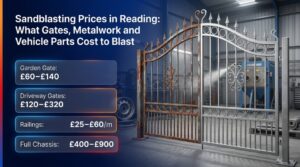
Cost depends on the size of the job, the component, and the level of corrosion. Individual car parts typically start from £50–£100. Wheel sets, subframes, and smaller chassis sections range from £100–£350. Full chassis blasting for a car or van can range from £350–£800+. Contact Blastec on 07387 446898 for a free, accurate quote based on your specific job.
Can sandblasting damage my car parts?
Not when carried out by an experienced operator using the correct media. At Blastec, we match the abrasive media to the component — softer media such as glass bead or soda for thin panels, aluminium, and alloy wheels; coarser grit for heavy chassis steel and structural components. Incorrect media selection or operator inexperience can cause warping or surface damage, which is why choosing a specialist matters.
How long does rust removal take?
Most individual component jobs are completed within one working day. Wheel sets and multiple parts typically take one to two days. Full chassis or bodyshell blasting may take two to three days depending on complexity and the level of corrosion present. We’ll give you a clear timeline before booking your job in.
Will rust come back after sandblasting?
Blasted bare metal must be primed or coated promptly — bare steel will begin to flash rust in humid conditions within hours. Once properly primed with a rust-inhibiting epoxy primer and finished with paint, powder coat, or cavity wax, the surface is fully protected and rust should not recur for many years with normal maintenance. We recommend having your protective coating applied the same day or the day after blasting wherever possible.
Is rust an MOT failure in the UK?
Yes, in specific areas. Corrosion affecting load-bearing or safety-critical components — including chassis legs, sills, suspension mounts, subframe pick-up points, and brake lines — is a statutory MOT failure in the UK. Cosmetic surface rust on non-structural body panels is typically recorded as an advisory. If you’ve received an MOT advisory for rust, it’s worth addressing it before your next test to avoid failure.
Do you offer mobile sandblasting near Reading?
Yes. For large items that can’t be transported — vehicles that aren’t roadworthy, large agricultural equipment, trailers, or fixed structural steelwork — we offer a mobile sandblasting service across Reading and the surrounding Berkshire area. Call us on 07387 446898 to discuss your requirements.
Do you work with classic car restoration projects?
Absolutely. Classic car restoration preparation is one of our specialisms. We work with private restorers and professional restoration workshops across Berkshire to blast bodyshells, chassis, and individual components. We’re experienced with older metal gauges and sensitive finishes, and we’ll always discuss the right approach for your specific vehicle before starting work.
Don’t Replace Your Parts — Restore Them Properly
Rust left untreated always costs more in the end. Whether you’ve got a single rusty component, a full chassis that needs stripping, or a classic car restoration project that needs professional preparation, Blastec Shotblasting Services in Reading is ready to help.
We make rust removal fast, thorough, and long-lasting — using professional-grade equipment and the experience to match the right method to every job.
📞 Call us: 07387 446898
🌐 Website: blastecreading.co.uk
📍 Based in Reading, Berkshire — serving the whole of Berkshire and surrounding areas